
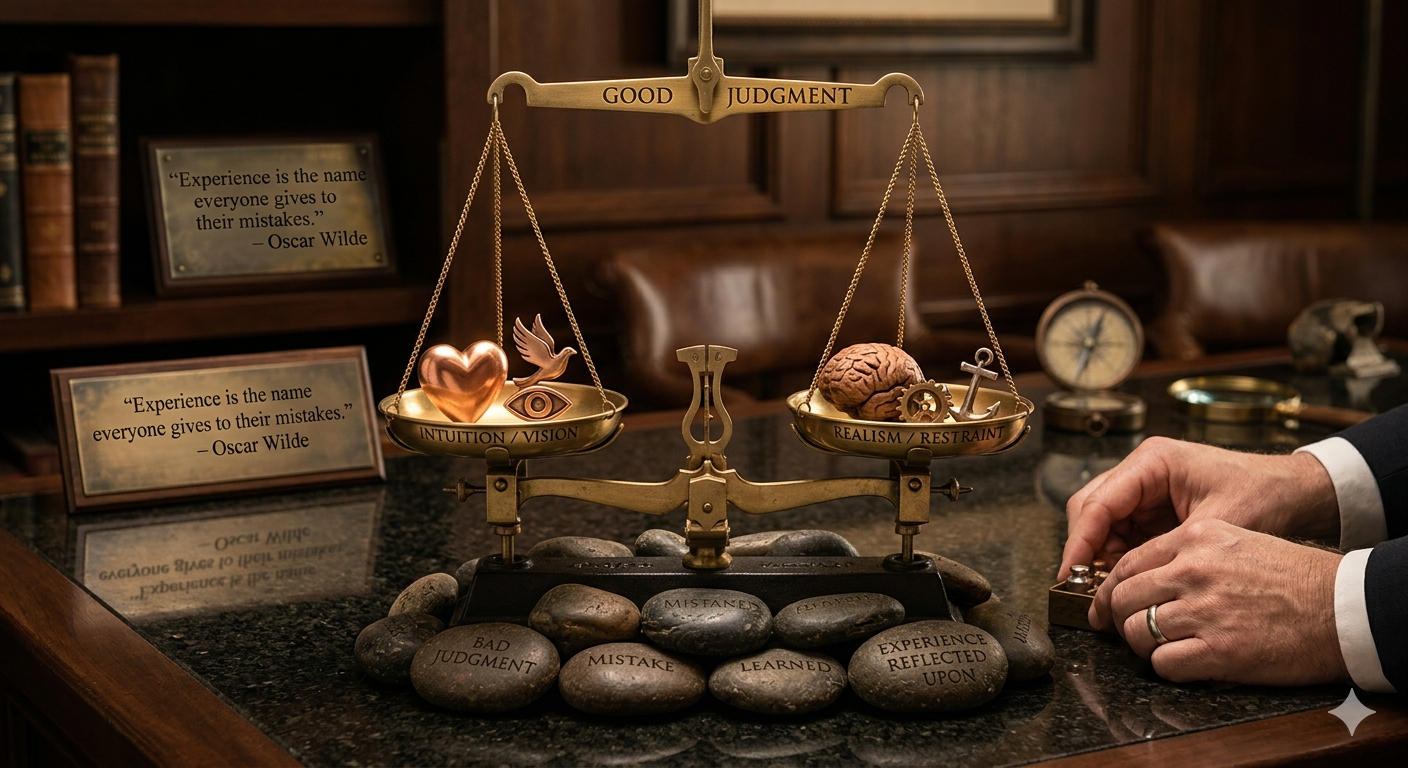
“Experience is the name everyone gives to their mistakes.” – Oscar Wilde
In the previous two posts, Play 30 and Play 31, I suggested that, ultimately, leadership is about good judgment, but I didn’t fully explain what that means. This post aims to clarify that, starting with a story I used to tell nearly all my mentees after stepping down as CEO and becoming the Non-Executive Chairman of the Board.
A young executive, recently appointed as president of a company, once asked his retiring predecessor, “What’s the secret to your success? How did you build such a strong reputation for good decisions?”
The older man replied, “Good judgment.”
Not quite satisfied, the young president pressed, “And how did you get good judgment?”
The older man leaned back and said, “Experience.”
Still not content, the young executive pushed one last time: “And how did you get experience?”
The old president smiled:
“Bad judgment.”
The Hard Way Is the Real Way
We all want to be recognized for good judgment. We want our decisions to be sound, our teams to trust us, and our results to speak for themselves. But this story is a quiet warning to every leader: there are no shortcuts to wisdom.
The path to good judgment is paved with mistakes. Not just small ones — often painful, embarrassing, and costly ones. Decisions that didn’t work. Risks that didn’t pay off. Conversations that went sideways. Moments we wish we could rewind.
But those moments shape us.
In fact, they shape the very thing we call “judgment” — that elusive quality that leaders are supposed to have, but no one’s quite sure how to teach.
What Is Judgment, Anyway?
Let’s pause and ask the question most of us skip:
“What is judgment, really?”
Judgment isn’t just decision-making. Anyone can make decisions — as simple as flipping a coin, following a formula, or delegating to others.
Judgment is the ability to weigh variables, scan consequences, listen to your inner compass, and act wisely — even when there’s no clear right answer.
It’s not intelligence. You can be brilliant and still make reckless choices.
It’s not knowledge. You can have data and still miss the forest for the trees.
It’s not even an experience by itself. Some people repeat the same mistakes over and over.
Judgment is experience reflected upon. It’s wisdom in action. It’s the blend of intuition, ethics, pattern recognition, and courage that allows a leader to say:
“This is the right call — and here’s why.”
Good judgment requires rationality and empathy, passion, and a sense of proportion. You can’t think your way into good judgment alone, and you can’t feel your way in either.
You must learn to balance heart and mind, vision and realism, urgency and restraint. And as any seasoned leader knows, that ability only emerges after years of trying, failing, learning, and trying again.
Experience Is a Terrible Teacher (But an Effective One)
You can read every leadership book ever written. You can attend seminars, hire mentors, consume content daily — and you should.
But no classroom can teach you what failure teaches you.
Experience makes things personal. It creates stakes. It forces reflection. It shapes memory. And when we face similar situations in the future, that experience becomes our internal compass.
It whispers: “You’ve seen this before. Don’t go down that road again.”
Or sometimes: “You made that mistake last time. Now you know better.”
That’s judgment forming: slowly, imperfectly, but reliably.
The Leadership Paradox
Here’s the paradox: the people we most admire for their wisdom are the ones who’ve made the most mistakes and learned from them.
But in today’s leadership culture, we often expect ourselves (and others) to be perfect from the start. We idolize certainty and polish. Our learning curves are hidden. We quietly fear the mess.
We forget that good judgment is the end product, not the starting point.
So when a team member makes a mistake, or when you stumble in your own role, ask yourself:
“Is this failure … or is this experience being earned?”
Because how you frame it changes how you lead through it.
A Personal Note
I’ve made plenty of decisions I wish I could take back. Some cost money. Some cost time. But in everyone, I gained something I couldn’t have gotten any other way.
I learned where my blind spots were.
I learned how others perceived my decisions.
I learned to listen better, not just to the voices around me, but to my own.
In my years of leading banks, negotiating under pressure, and building teams, I’ve seen this pattern again and again. The leaders who develop the best judgment are those who dare to make decisions and have the humility to learn from them.
What This Means for Us
If you’re early in your leadership journey, don’t be afraid to get it wrong sometimes. Make the best decisions you can with the information you have. Reflect when things don’t go well. Own your part. Stay teachable.
If you’ve been leading for a while, don’t pretend your good judgment was magic. Share your story. Tell your team about the moments of poor judgment that taught you the most. That vulnerability builds trust and equips the next generation to lead better, faster.
And if you’re mentoring others, don’t just give advice. Give context. Share the cost behind your certainty. Let them know what it really took to build your judgment muscle.
One Final Thought
The next time someone praises your good judgment, smile.
And remember all the bad judgment it took to get there.
Questions for Reflection
1. What’s one mistake you’ve made that taught you something essential?
2. How does that lesson guide your decisions today?
Download the Chairma’s Playbook Worksheet — Play 32: The Cost of Good Judgement
📚Further Reading
1. Noise: A Flaw in Human Judgment — Daniel Kahneman, Olivier Sibony & Cass Sunstein
Explores how inconsistency and “noise” distort judgment, even among experienced professionals, and how leaders can improve decision quality.
2. Judgment: How Winning Leaders Make Great Calls — Noel Tichy & Warren Bennis
A leadership classic that examines how experienced leaders develop judgment and why good calls come from accumulated experience and reflection.
3. The Effective Executive — Peter F. Drucker
A timeless leadership book emphasizing that effective executives make decisions through disciplined thinking and self-awareness.
4. How We Decide — Jonah Lehrer
Explores how the brain integrates emotion and reason in decision-making and why experience plays a crucial role in sound judgment.
5. Judgement at Work — Andrew Likierman
A modern framework explaining how leaders develop sound judgment and how organizations can cultivate it.
As at Amazon Associate, I earn from qualifying purchases. This means that if you click on a link in this post and make a purchase, I may receive a small commission, at no extra cost to you. Your support helps keep The Chairman’s Playbook going, and I’m grateful for it.
Leave a Reply