
(When Logic Isn’t Enough)
“Intuition is seeing with the soul.” — Dean Koontz
The Quiet Voice That Knows
Every leader eventually reaches a moment when data, experience, and logic all seem insufficient. The spreadsheets say one thing, the consultants another, yet deep inside, something whispers: go the other way.
That whisper is intuition — a quiet sense of knowing without fully knowing why.
In my career, some of my most decisive moments did not emerge from analysis, but from instinct — what I call “gut intelligence”. I’ve ignored it at times and paid the price. Other times, when I trusted it, I later realized it was my mind connecting subtle cues faster than I could explain.
Intuition, in leadership, isn’t mystical. It is experience, pattern recognition, memory, and emotional attunement working below the surface. It often appears suddenly, but it is usually built over years of observation, mistakes, and reflection.
That is why intuition matters. Leaders are rarely paid simply to process information. They are paid to make sense of incomplete information under pressure, with real consequences.
Beyond Logic: When Intuition Leads
In the early 1990s, while leading the Romanian Bank for Foreign Trade, logic alone could not guide every decision. The country was transforming, institutions were fragile, and many rules were still being written in real time.
In one negotiation, my advisors recommended caution. Their reasoning was sound. On paper, restraint seemed wise. Yet something felt wrong — not in what the other side said, but in how they said it: a hesitation here, an avoided glance there, a pause just a fraction too long.
My instinct pushed me to act more boldly than the analysis suggested. It seemed risky, even irrational. But it proved right.
In hindsight, it was not luck. It was accumulated experience expressing itself instantly.
That’s the paradox of intuition: it feels spontaneous, but it is built slowly. What appears to be a flash is often the compressed result of years of paying attention.
The Myth of Reliable Intuition
For all its power, intuition also has a dangerous reputation: we tend to trust it more than we should.
One of the most important lessons I learned — often the hard way — is that intuition is not universally reliable.
There were moments when I felt certain about a person, a deal, or a strategy, only to discover later that my confidence had been misplaced. It felt like insight. In reality, it was bias dressed up as certainty.
This is the central myth: that intuition is always wisdom.
It isn’t.
Daniel Kahneman has shown that intuitive judgments depend heavily on the environment in which they are formed. In stable settings with recurring patterns and quick feedback — like chess — intuition can be highly accurate.
But in complex, ambiguous environments — the kind most leaders operate in — intuition can mislead.
We see patterns where none exist.
We trust confidence over competence.
We mistake familiarity for truth.
We turn emotional reactions into strategic conclusions.
That is why leaders must respect intuition without romanticizing it.
When Intuition Becomes Bias
I recall situations where my “gut feeling” about a senior hire was overwhelmingly positive. The chemistry was strong. The conversation flowed. Everything felt right.
Months later, performance told a different story.
What I had interpreted as clarity was, in fact, bias. I had confused personal ease with professional fit.
That experience taught me a discipline:
Never trust intuition just because it feels strong. Trust it only when it has earned its credibility.
Three filters help:
Experience: Have I truly seen this pattern before?
Feedback: Have my judgments in this domain been tested and corrected over time?
Environment: Is this a field of real patterns, or one filled with noise?
If these are missing, intuition is a hypothesis — not a conclusion.
Good leadership is not about following your gut blindly. It is about interrogating it honestly.
The Science Behind the Gut
Psychologists like Daniel Kahneman describe intuition as System 1 thinking — fast, automatic, and often accurate when grounded in deep experience.
Research on decision-makers in high-pressure roles shows that experts often do not compare long lists of options. They recognize patterns. They sense what matters. They know quickly what deserves attention.
The key distinction is this: intuition works when experience is deep and contextually relevant. Without that, it becomes guesswork or bias, wearing the costume of wisdom.
Leaders must therefore cultivate both — the discipline of analysis and the awareness to trust intuition when it’s earned.
Learning to Listen
Modern leadership often overvalues visible certainty and undervalues quiet discernment. We celebrate those who “follow the data,” yet the most effective leaders know that data rarely interprets itself.
Numbers inform decisions, but they do not make them. At some point, a leader must still decide what matters, what is missing, and what risk is worth taking.
Listening to intuition requires something many executives neglect: space.
Reflection. Distance. Stillness.
In my later years as chairman, I noticed that some of my best decisions did not come from crowded meetings or endless debate. They came from stepping away — walking, thinking, letting the signal emerge from the noise.
Intuition speaks softly. The louder the environment, the harder it is to hear.
The Balance Between Gut and Grid
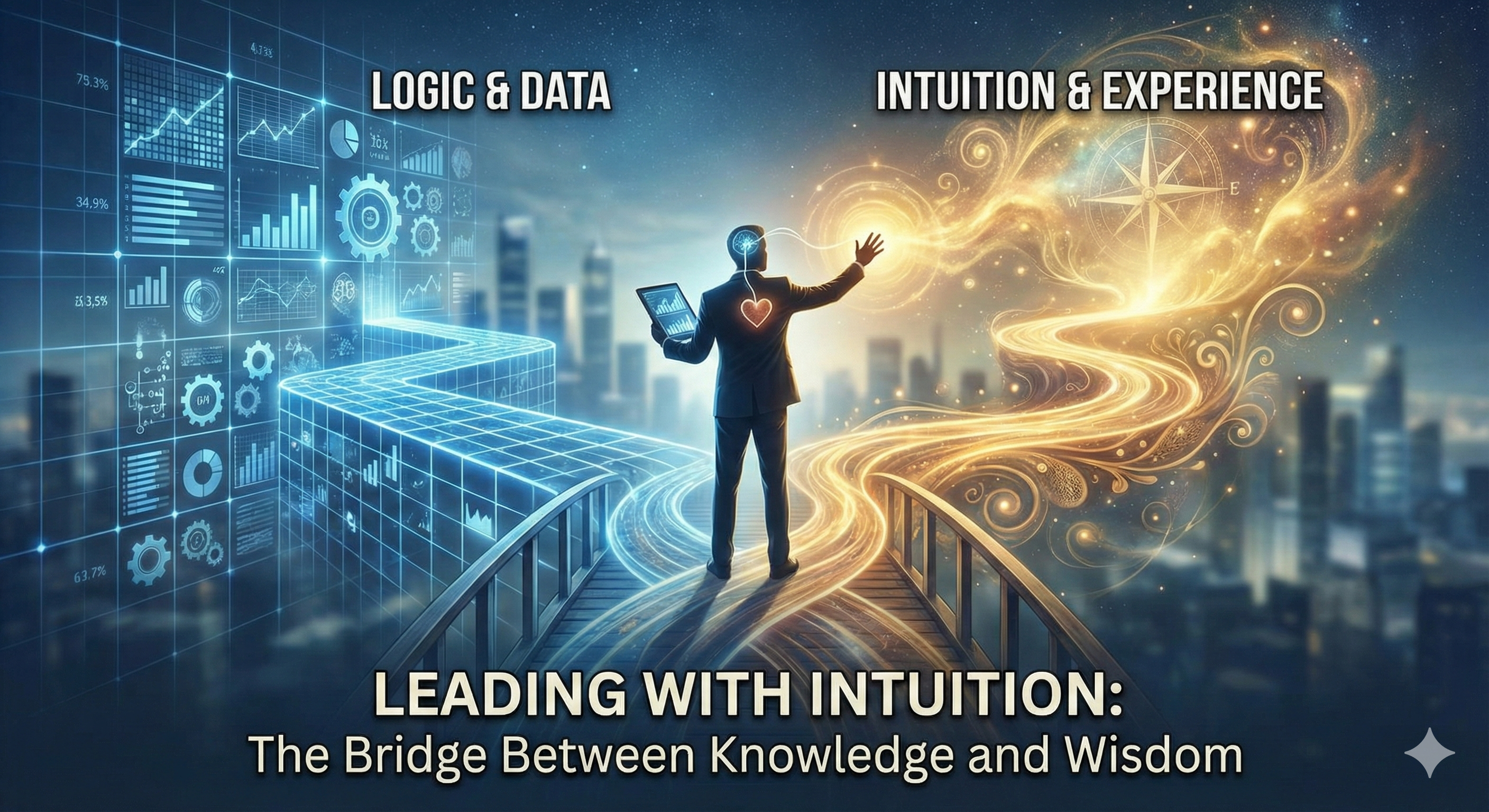
Intuition is not a replacement for logic; it is its partner. Leadership requires both the gut and the grid.
- Use logic to test your intuition.
- Use intuition to challenge your logic.
If they align, act with confidence. If they diverge, pause and investigate. That tension is often where judgment is formed.
The best leaders are neither cold analysts nor impulsive feelers. They are integrators.
Cultivating Intuitive Intelligence
To strengthen intuition:
- Reflect regularly — insight often emerges in quiet moments.
- Review decisions — learn when your instinct was right or wrong.
- Broaden experience — richer exposure builds better internal patterns.
- Notice your emotions — they may reveal signals, but they may also reveal distortions.
- Seek disconfirming views — intuition improves when challenged, not merely obeyed.
Intuition, like a muscle, strengthens with use and reflection.
When Logic Isn’t Enough
At this stage of my life, I see intuition as one of leadership’s most under-appreciated assets. It is not anti-rational. It extends what logic alone can achieve.
As Albert Einstein observed, “The intuitive mind is a sacred gift and the rational mind is a faithful servant.” Leadership is learning to honor both.
In a world obsessed with data, intuition remains the bridge between knowledge and wisdom.
Intuition may help a leader sense the right direction. But intuition alone is not enough. It becomes truly valuable only when shaped by reflection, experience, and principle — in other words, by wisdom.
📄 Download The Chairman’s Playbook Worksheet — Play 33: Leading with Intuition
📚Further Reading
Blink: The Power of Thinking Without Thinking — Malcolm Gladwell
Popularizes “thin-slicing” — rapid judgments based on limited information.
Shows when snap decisions can outperform analysis — and when they fail.
The Power of Intuition — Gary Klein
Deeply aligned with your leadership examples.
Explains how experts make fast, high-quality decisions under pressure.
The Intelligence of Intuition — Gerd Gigerenzer
A more nuanced counterpoint to Kahneman and Tversky
Argues intuition can be smart — but only in the right environments.
Judgment Under Uncertainty: Heuristics and Biases — Amos Tversky and Daniel Kahneman
The academic foundation of your “intuition becomes bias” section.
Explains how mental shortcuts systematically distort decisions.
Decisive — Chip Heath & Dan Heath
A practical framework to counter flawed intuition in leadership decisions.
As an Amazon Associate, I earn from qualifying purchases. This means that if you click on a link in this post and make a purchase, I may receive a small commission at no extra cost to you. Your support helps keep The Chairman’s Playbook going, and I’m grateful for it.
Leave a Reply