
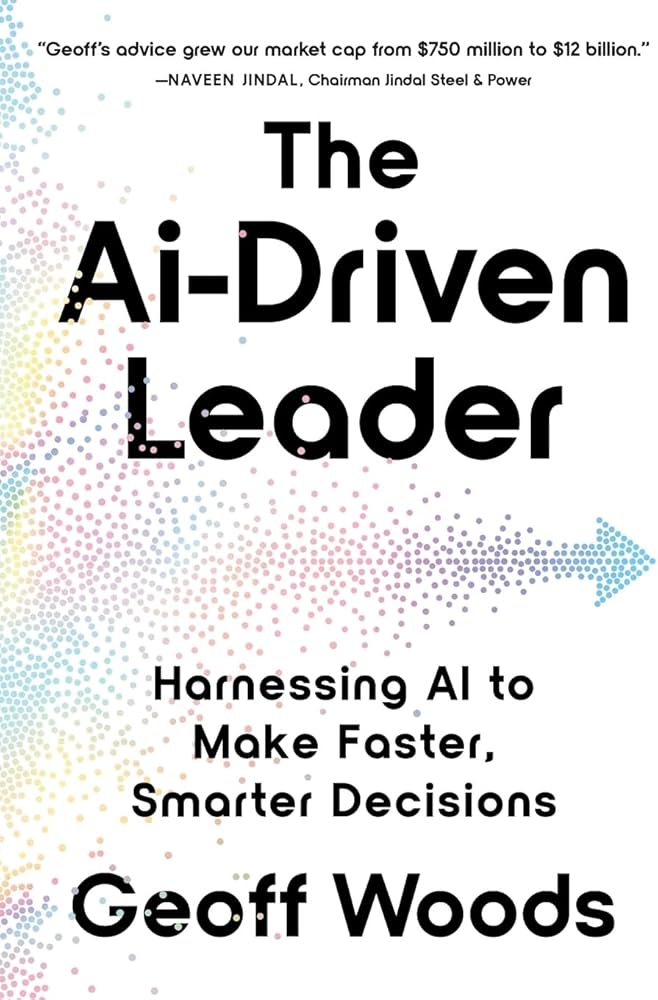
There is a great deal of noisy language around AI. Some of it is breathless. Some of it is fearful. Much of it confuses tools with transformation. Geoff Woods, in “The AI-Driven Leader: Harnessing AI to Make Faster, Smarter Decisions,” cuts through that noise with a clear proposition: AI matters not because it is fashionable, but because it can improve how leaders think, decide, and execute.
He frames AI not as a substitute for leadership, but as a strategic ally — a “Thought Partner.”
That distinction is crucial. Woods’s most useful insight is simple: “AI is your Thought Partner.” But you remain responsible for judgment, direction, and accountability. He sharpens the point elsewhere: “Thought leader. AI is your thought partner.” The order matters. AI can accelerate thinking, but it cannot carry responsibility. It can support judgment, but it cannot replace character.
AI Raises the Bar for Leaders
For many years, leaders derived part of their advantage from access to information. They knew more than others. They had earlier visibility, better data, and more time to synthesize events. AI changes that equation. Information is becoming cheaper, faster, and more widely available. That means the advantage of leadership is shifting from access to information toward interpretation, judgment, and clarity.
In practical terms, AI can summarize reports, generate alternatives, analyze patterns, challenge assumptions, and help leaders structure decisions faster than before. But speed, by itself, is not wisdom. A leader who moves faster without thinking better simply makes bigger mistakes at higher velocity. Woods’s subtitle gets the balance right: “faster, smarter decisions.” Not just faster. Smarter.
This is where the book becomes more than a technology manual. It becomes a leadership book. The real issue is not prompt-writing. The real issue is whether leaders can use AI to improve the quality of their thinking rather than outsource it. That is a far more demanding challenge.
The Real Danger: Amplified Weak Thinking
One of Woods’s most important warnings is that AI magnifies the quality of the thinking behind it. As he writes, “people are often unaware of their biases and assumptions.” And if those assumptions are flawed, the technology will not rescue them. On the contrary, “If you ask AI to build on flawed foundations, it will simply magnify the mistakes.”
That is a profoundly important leadership lesson.
Weak leaders often hope technology will compensate for shallow thinking. It will not. AI can make poor reasoning sound polished. It can make vague ideas appear structured. It can make untested assumptions feel convincing. But none of that makes them true. In this sense, AI does not reduce the need for leadership judgment; it increases it.
The same tool in different hands produces very different outcomes. A weak leader uses AI to look smarter. A strong leader uses AI to become clearer. A weak leader uses it to avoid hard thinking. A strong leader uses it to deepen hard thinking. AI is an amplifier. It does not erase leadership quality; it reveals it.
Strategic Clarity Becomes the Premium
Woods promises that leaders can “escape operational overwhelm and lead with strategic clarity.” That phrase captures one of the central pressures of modern executive life. Most leaders are not suffering from too little information. They are suffering from too much of it — too many dashboards, too many emails, too many meetings, and too many moving parts. Their problem is not data scarcity. It is cognitive overload.
Used properly, AI can help relieve that overload. It can reduce the time spent on routine synthesis and free leaders to focus on the work only they can do: framing the real problem, setting priorities, aligning people, and making difficult trade-offs. The value of AI, then, is not merely efficiency. It is executive leverage.
This is why Woods is right to position AI as a leadership tool, not only a productivity tool. The promise is not just that you get more done. The promise is that you get more of the right things done — with greater coherence, faster learning, and sharper decisions.
What Must Remain Human
The more AI expands, the more visible the human side of leadership becomes. No team is inspired by a machine. No institution grants moral authority to an algorithm. No difficult moment of change, crisis, or ambiguity is resolved by data alone. Leadership still depends on trust, courage, judgment, emotional steadiness, and the ability to create meaning for others.
That is why the best leaders will not be those who worship AI, nor those who reject it. They will be those who integrate it wisely while preserving what is distinctly human. They will know when to consult the machine and when to overrule it. They will know when speed matters and when reflection matters more. They will know that leadership is not about producing answers mechanically, but about helping people move forward intelligently and responsibly.
The future does not belong to leaders who abdicate their thinking to AI. It belongs to leaders who use AI to sharpen their thinking while keeping responsibility fully their own.
The Leadership Shift
One of the short quotes associated with the book says, “The true purpose of a goal is to act as a compass, guiding you toward who you can become.” I like that because it reminds us that leadership is not only operational. It is developmental. AI may help leaders make better decisions, but those decisions still shape the kind of leader one becomes.
So the deeper question is not simply, “How can I use AI?” It is, “Who do I become as I use it?” Do I become more thoughtful or more dependent? More strategic or more reactive? More human or less?
That is why The “AI-Driven Leader” deserves attention. Geoff Woods is not arguing that AI is the new leader. He is arguing that, in the right hands, AI can help leaders think better, decide faster, and act more strategically. But only if we remember the hierarchy he insists on: the human must remain the thought leader.
And that may be the most important leadership principle of the AI age.
If you’d like to explore the book yourself, you can find it here on Amazon.
As an Amazon Associate, I earn from qualifying purchases. This means that if you click on a link in this post and make a purchase, I may receive a small commission at no extra cost to you. Your support helps keep The Chairman’s Playbook going, and I’m grateful for it.
Leave a Reply