
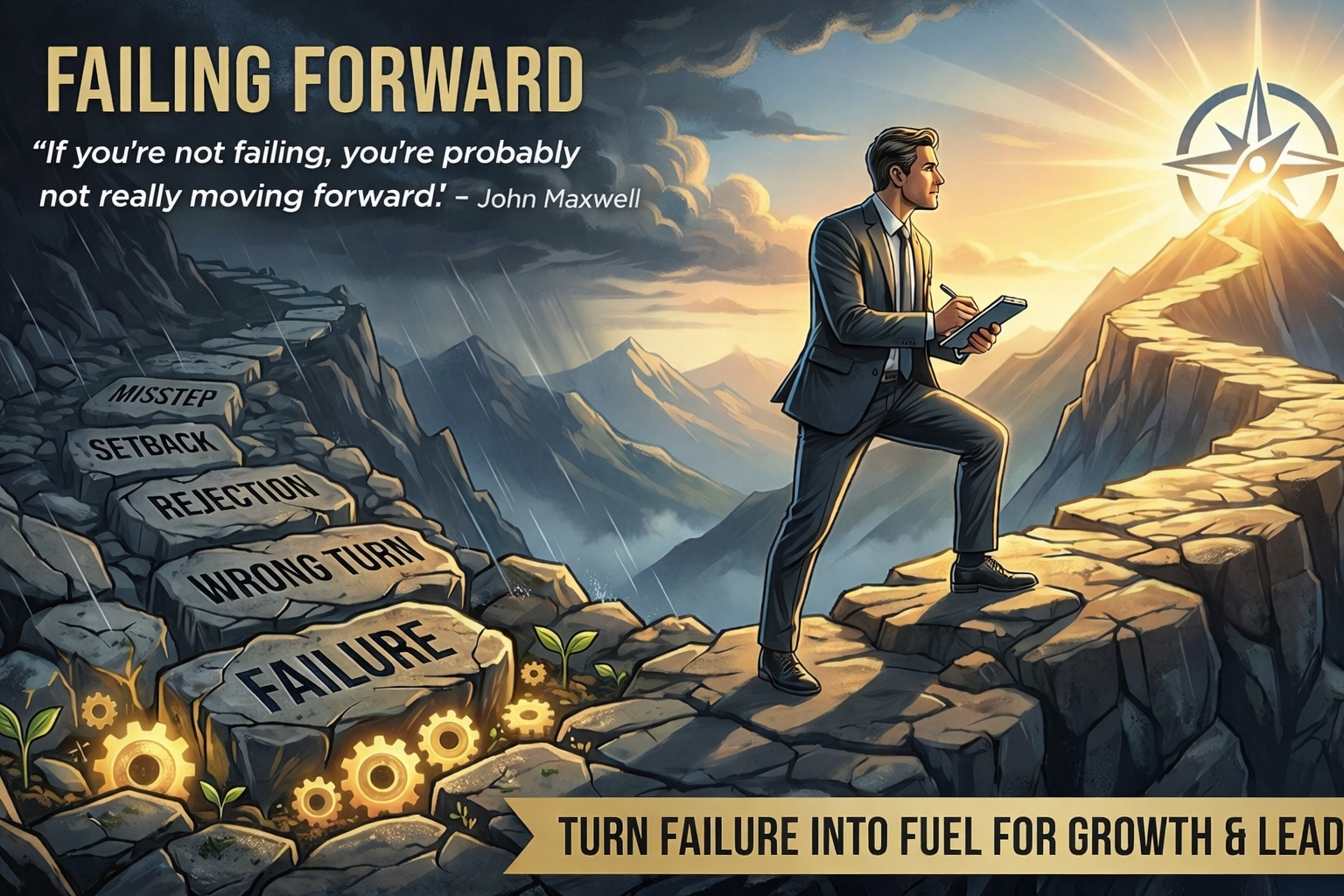
“If you’re not failing, you’re probably not really moving forward.” – John Maxwell
I first encountered the phrase “failing forward” in John Maxwell’s book of the same name. At the time, I was navigating one of those seasons every leader eventually faces — where results fall short, decisions backfire, and the path ahead looks uncomfortably uncertain.
Maxwell’s message reframed how I thought about failure.
He argued that successful people aren’t the ones who avoid mistakes — they’re the ones who use them. Instead of seeing failure as an ending, they treat it as information, as feedback, and as fuel.
The concept stuck with me. Over the years, I’ve learned that how we handle failure says far more about our leadership than how we handle success.
What Does It Mean to Fail Forward?
Failing forward doesn’t mean ignoring mistakes.
It doesn’t mean pretending everything is fine.
It doesn’t mean spinning a polished story around a painful setback.
It means taking failure — raw, honest, and sometimes embarrassing — and turning it into fuel.
It’s the difference between:
• Dwelling on the past vs. learning from it.
• Being defined by a setback vs. being refined by it.
• Using failure as an excuse to quit vs. a reason to grow.
The truth is, anyone can fail.
What matters is what happens next.
To fail forward is to let failure push you — not down, but forward. Toward maturity, wisdom, and ultimately better leadership.
A Personal Moment of Falling Short
Years ago, I led a major strategic initiative that looked excellent on paper. The totals aligned. It was a compelling vision. The logic was obvious. But six months in, the internal culture didn’t align with the change — and neither did the external environment.
We hadn’t accounted for certain market dynamics. Our timeline was too ambitious. And, perhaps most of all, I underestimated the level of resistance within my team.
The project didn’t collapse, but it fell short of expectations. Morale suffered. Relationships strained. And I carried the heavy weight of having misjudged the situation.
What surprised me wasn’t the setback itself. It was how quickly failure tries to recruit your mind into unhelpful scripts:
- “You should have known better.”
- “You’ve lost credibility.”
- “Play safe next time.”
That’s the moment that matters most. Because failure always offers a bargain: shrink now, and you won’t feel this again. But the price of that bargain is your future.
So I chose a different path. I didn’t walk away from it. I walked through it — questions first, defensiveness last. I owned what was mine to own. I listened to what my team had experienced. I revisited assumptions that had quietly hardened into “truth.” And I asked what we needed to change, not just in the plan, but in the way we led it.
That experience became one of my greatest teachers — not because it happened, but because I didn’t waste it.
The Myth of Clean Wins
In leadership, there’s an unspoken pressure to present a flawless track record. We imagine success should be smooth, deliberate, tidy.
No bruises.
No public missteps.
No uncertainty.
But genuine success — especially in leadership — is rarely tidy. It’s messy, iterative, and often full of reversals.
Ask any leader you admire and you’ll hear the same pattern:
Success didn’t arrive in a straight line.
It came through stumbles.
Wrong turns.
Risky bets.
Hard conversations.
Public failures.
Private doubts.
And most of all — it came from getting back up. Again and again.
Failing forward isn’t glamorous. But it’s essential. Without it, leaders don’t grow—they just repeat what once worked until it stops working.
The Discipline of Reflection
Failing forward doesn’t happen by accident.
Failure alone doesn’t teach you anything — reflection does.
That’s where growth begins.
When things go wrong, the leaders who grow are the ones who ask:
• What is this teaching me?
• Where was I blind?
• What assumptions did I make?
• How did I respond under pressure?
• What could I do differently next time?
You can’t always control what went wrong. But you can always choose what you take from it.
Every failure has a lesson. But the learning isn’t automatic — it’s intentional.
Progress Requires Risk
If you’re never failing, you’re probably not leading boldly.
You’re probably playing it safe.
Sticking to what you know.
Avoiding the edges where growth lives.
Leadership is inherently risky. You’re deciding without guarantees.
You’re moving people toward something new. You’re stepping out on ground that may not be solid.
If you lead long enough, you’ll get it wrong sometimes.
But that’s not a problem.
It’s proof that you’re trying.
The only thing worse than failure… is inaction.
Failing in Front of Others
Here is the most challenging aspect: failing forward frequently occurs in public.
In front of your team, your clients, your board, your family, your community.
It’s tempting to hide it, minimize it, spin it or act confident, even if you’re not.
But here’s the paradox: when you lead through failure with honesty, you don’t lose trust — you often gain it.
People don’t expect perfection from leaders. What they expect is ownership, clarity, and courage.
When you acknowledge a misstep, reflect out loud, and keep moving forward, you model something rare and powerful: accountability without collapse, humility without weakness, resilience without denial.
In this way, failing forward isn’t just personal growth.
It’s a form of leadership.
Because your response teaches your team what failure means here:
- Is it a crime — or a classroom?
- Is it something to hide — or something to learn from?
- Does it end careers — or sharpen them?
Culture results less from leaders’ words and more from their actions during difficult times.
One Final Thought
Failure isn’t a detour in the leadership journey.
It’s part of the main road.
You can’t avoid it.
But you can decide what to do with it.
When it comes, don’t fall back.
Fail forward.
That single choice may define your entire trajectory.
🧭 Questions for Reflection
1) What’s one failure in your life that truly moved you forward?
2) What did it teach you about your judgment, your character, or your priorities?
3) If that same situation happened again today, what would you do differently—and what would you do the same?
📄 Download The Chairman’s Playbook Worksheet — Play 26: Failing Forward
📚Further Reading
- John C. Maxwell — Failing Forward: Turning Mistakes into Stepping Stones for Success
The classic behind your theme: how to reframe failure as feedback, keep perspective, and convert setbacks into growth. - Matthew Syed — Black Box Thinking: Why Most People Never Learn from Their Mistakes—But Some Do
A powerful case for learning cultures: turning errors into data, reducing blame, and building systematic improvement. - Ryan Holiday — The Obstacle Is the Way: The Timeless Art of Turning Trials into Triumph
Stoic, practical, and aligned with “fail forward”: obstacles as raw material for resilience and forward motion. - Charles Duhigg — The Power of Habit
Useful for the “what happens next” part of failing forward: how leaders and teams change behaviors after setbacks. - Brené Brown — Daring Greatly
The emotional leadership side of failing forward: vulnerability, courage, and creating trust when things go wrong.
Leave a Reply