
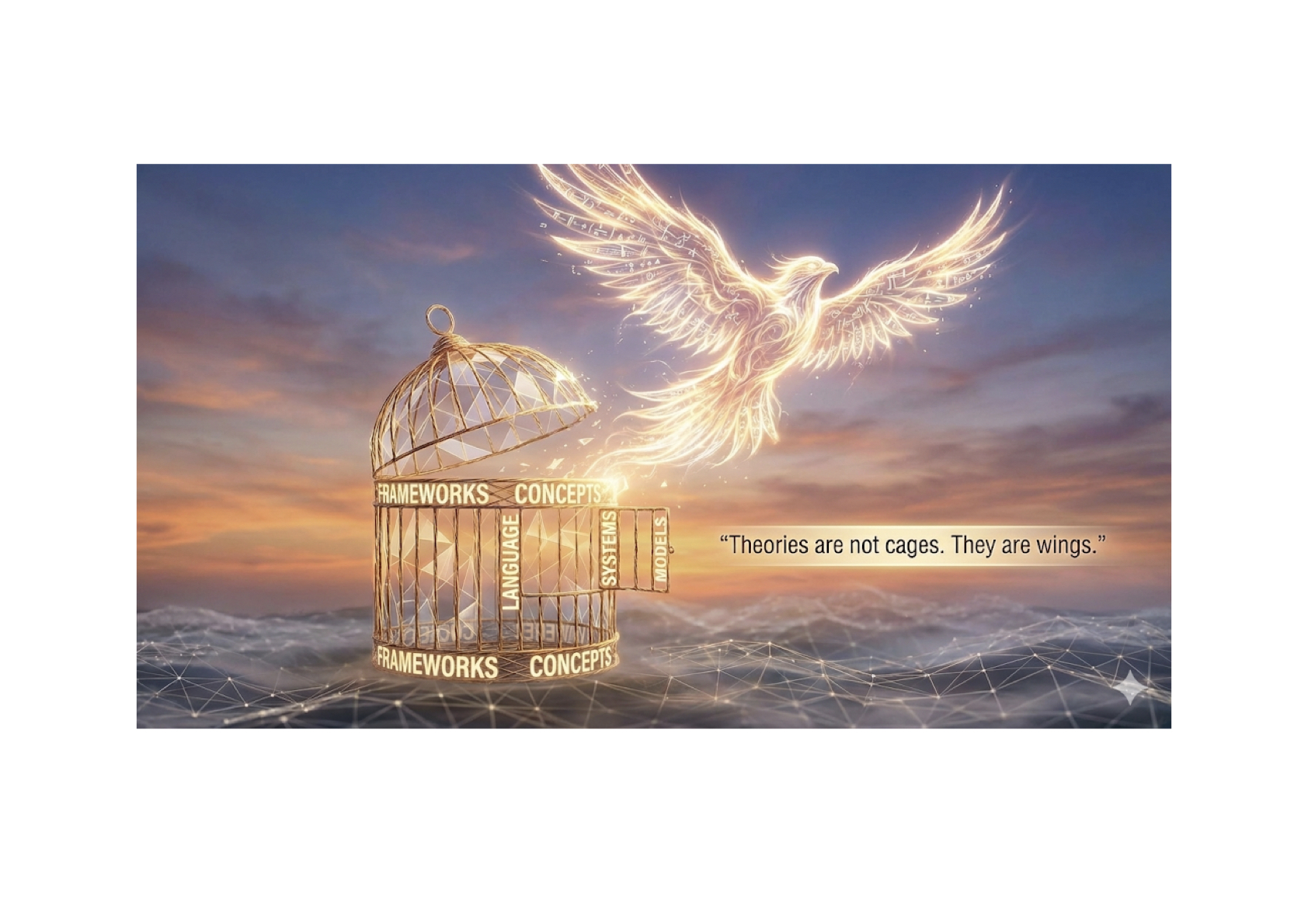
“Nothing is as practical as a good theory.” — Kurt Lewin
Am I Being Too Theoretical?
I sometimes wonder whether readers find my posts a little too philosophical. Perhaps, I refer too often to theories and concepts when they would prefer practical advice.
I understand. In business, we value experience and results. We want to know what works, preferably without a lengthy explanation of why.
Having spent much of my life in boardrooms, I see things differently. Understanding why something works matters at least as much as knowing that it works. That is where theory helps.
We All Have Theories
There is something amusing about people who dismiss theory in favor of experience. They usually have their own theories. They don’t call them that.
A manager who believes employees need close supervision has a theory about human behavior. So does one who believes that people perform better with autonomy.
Every decision rests on assumptions about how the world works. The question is whether we examine those assumptions or take them for granted.
Experience is invaluable, but it can also reinforce mistaken beliefs. I would rather understand the assumptions behind my judgment than rely on intuition alone.
From Information to Understanding
We have more information available than ever before. I am less certain that we understand the world any better.
Consider a company losing market share. Management may have extensive data about sales and competitors. But is the cause pricing, product quality, changing customer preferences, or a deeper industry shift?
Information tells us what is happening. Concepts and theories help us investigate why. They allow us to recognize relationships and distinguish symptoms from causes.
Without that understanding, we risk becoming very efficient at solving the wrong problem.
Conceptualization Needs a Language
In an earlier post about conceptualization, I discussed the leader’s ability to recognize patterns, connect apparently unrelated developments, and see the larger picture.
But to conceptualize, we need concepts to think with. And we need to understand their language.
Take complicated and complex. We often use them interchangeably, yet the distinction matters. We can usually analyze a complicated problem by examining its components. In a complex situation, interactions can produce unexpected outcomes — the two call for different approaches.
Every profession depends on such distinctions. We would not expect a physician to practice without understanding medical terminology. Why should leadership be different?
I am not defending management jargon. I have attended enough meetings where impressive words concealed a lack of understanding. Mastering conceptual language means grasping the ideas behind the words, not using them to impress others.
The better we understand our concepts, the more precisely we can think — and the more clearly we can explain our reasoning to others.
A Lesson from Banking
I appreciated this early in my career. In 1975, I participated in negotiations in Paris concerning an issue of Euro notes for Romania when the country was entering international financial markets.
I was young and had much to learn. It quickly became clear that knowing financial terminology was not enough. I needed to understand the mechanisms behind the words, the relationships between the parties, and the implications of what we were negotiating.
Translating an expression into Romanian was one thing. Understanding the underlying concept was another.
That experience strengthened a conviction I have carried into management and leadership: mastering a profession’s language is part of mastering the profession itself.
Preparing for the Unfamiliar
Experience concerns situations we have already encountered. Leadership often confronts us with situations we have not.
When Romania began its transition to a market economy in the early 1990s, no established playbook existed for many of the decisions we faced. Some previous experience was of limited use because the conditions had changed fundamentally.
Our knowledge of economics, financial markets, and management did not supply ready-made answers. It did, however, help us understand unfamiliar problems and consider alternatives.
Theory cannot predict everything. But it can prepare our thinking for circumstances beyond our personal experience.
Theory Is Not a Substitute for Judgment
None of this means we should accept theories uncritically. Additional evidence challenges some work only under particular conditions.
I have never believed that applying models can fully capture what leadership is. A useful theory helps us ask better questions. It does not relieve us of the responsibility to judge whether its assumptions fit the situation.
Practice should challenge theory, just as theory should inform practice.
Putting Theory to Work
So what might you do with this argument?
Think of an important decision you are facing. What assumptions are you making about the people involved, the circumstances, or the likely consequences? Why do you believe those assumptions are sound?
Then ask whether a concept or theory you have encountered offers another way of looking at the problem.
You do not need to become an academic or memorize management models. You need to develop the habit of questioning your assumptions, looking for explanations, and connecting what you learn with what you experience.
And when the outcome differs from what you expected, ask yourself whether the problem was your decision or the assumptions behind it.
That is how theory becomes useful. Not when we can explain it, but when it helps us think more clearly, make better decisions, and learn from the consequences.
Why I Will Keep Referring to Theory
I do not quote thinkers because I consider academic knowledge superior to experience. I refer to their ideas because they have helped me interpret my experience, question what I thought I knew, and sometimes change my mind.
After decades of making decisions, I remain convinced that experience alone is not enough. We also need the intellectual tools to understand it.
So I will keep reading, questioning, and occasionally bringing a little more theory into these posts.
I hope you will bear with me.
One question to leave you with: What assumption is guiding an important decision you are making today — and when did you last question it?
Questions for Reflection
- What important decision or challenge are you facing now?
- What do you currently believe is causing the situation?
- Which assumptions are supporting your judgment?
Download the Chairman’s Playbook Worksheet — Play 64: Why We Need Theory
📚Further Reading
1. The Tacit Dimension — Michael Polanyi (1966)
Examines the knowledge we possess but cannot always articulate. Particularly useful for understanding the relationship between experience, intuition, conceptual knowledge, and professional judgment.
2. The Concept of Mind — Gilbert Ryle (1949)
Explores the relationship between knowing how and knowing that. Offers a philosophical perspective on practical intelligence and why competence cannot be reduced to memorizing theoretical propositions.
3. Chris Argyris & Donald Schön — Theory in Practice: Increasing Professional Effectiveness (1974)
Explores how our actions are guided by implicit theories and how examining these assumptions improves professional judgment and effectiveness.
4. Donald Schön — The Reflective Practitioner: How Professionals Think in Action (1983)
Explains how professionals develop understanding through reflection on experience, connecting theoretical knowledge with practical action.
5. Kurt Lewin — Field Theory in Social Science (1951)
Demonstrates the importance of theoretical frameworks for understanding human behavior and social dynamics.
As an Amazon Associate, I earn commissions from qualifying purchases linked in this post without additional costs to readers – thank you for supporting the endeavors behind ‘The Chairman’s Playbook’!
Leave a Reply