
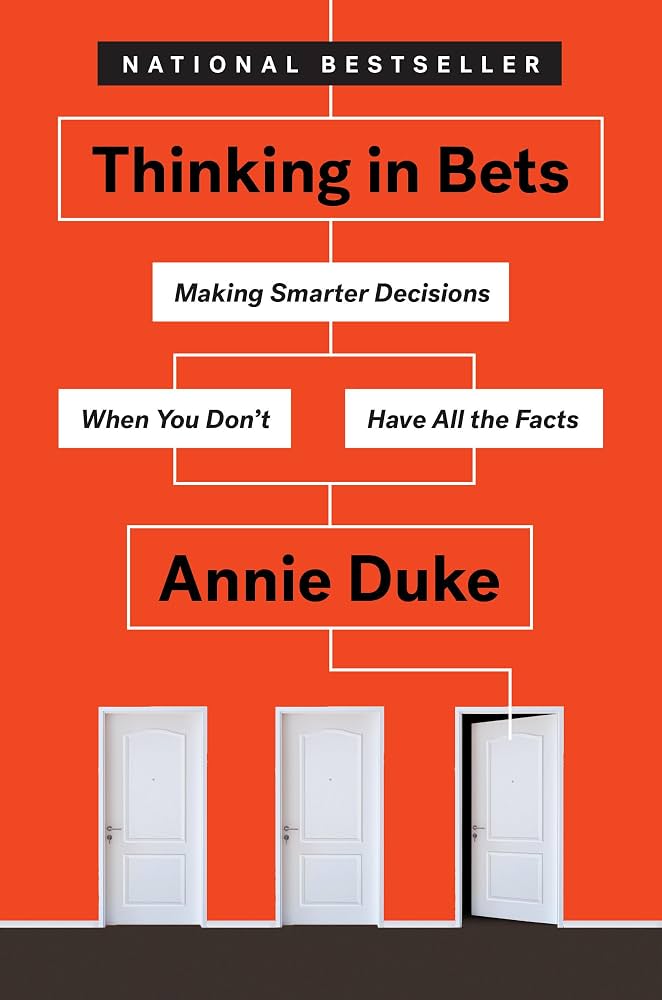
“A great decision is the result of a good process.” — Annie Duke
In 2007, we were planning to expand our bank’s network to 300 branches. Then came the financial crisis of 2008, and we canceled the expansion plan.
Looking back, it is tempting to judge the earlier ambition entirely through what happened afterward. Yet a serious assessment must reconstruct what we knew when we made the plan, which assumptions we relied on, and which risks we should reasonably have recognized.
That distinction is central to Annie Duke’s “Thinking in Bets.” Drawing on her experience as a professional poker player, she examines a problem familiar to anyone who has carried responsibility: we must decide before we know how things will turn out.
What interests me most is what this means for how leaders learn. If we misread the results of our decisions, experience can reinforce our mistakes.
When Results Mislead Us
Duke calls the habit of judging a decision by its outcome “resulting”. A successful outcome persuades us that our reasoning was sound; a disappointing one seems to prove that we were wrong.
Consider a manager who appoints someone after careful interviews, references, and discussion of the role. The appointment may still fail. Another manager hires an old friend without examining whether the person fits the job, and the appointment succeeds.
We cannot assess the two decisions fairly from those results alone. The first deserves investigation; the second may conceal a weakness that will eventually become costly.
For a board, this matters enormously. If we reward every success without analysing how the team achieved it, we may encourage recklessness. If we punish every failure, people learn to protect themselves by choosing whatever is easiest to defend.
Results are evidence. We still have to interpret them.
A careful process also needs scrutiny. We may have ignored an available warning or consulted only people who agreed with us. Calling a failure bad luck cannot be a convenient way to avoid responsibility.
Thinking in Bets: How Sure Are We?
Duke writes: “We have to make peace with not knowing.”
That is uncomfortable advice for leaders accustomed to being asked for answers. Yet admitting uncertainty can make a discussion more precise.
Imagine a management team estimating a 70 percent chance that a new service will reach its first-year target. That estimate invites scrutiny: what supports it, and what might prevent success? The possibility of missing the target is already part of the judgment.
Of course, attaching a percentage to an opinion does not make it scientific. A number can disguise wishful thinking as easily as a confident speech can. Its usefulness lies in exposing assumptions and making them open to challenge.
Duke’s brief question, “Wanna bet?”, tests how firmly we believe what we say. Would we commit resources on that basis? What information would make us reconsider?
There is also room between accepting a claim completely and rejecting it outright. A colleague’s evidence may lower our confidence without overturning our conclusion. We can still decide to proceed while reducing the commitment or arranging an earlier review. That response is useful when the new information is incomplete but too significant to ignore.
Making Disagreement Useful
The book also examines how other people can help us question our beliefs. We need people willing to challenge our interpretation, including when agreement would be more comfortable.
For a presiding officer, this has a practical implication. When I announce a strong view too early, I risk shaping every contribution that follows. Colleagues may refine my proposal before anyone has properly questioned it.
A better discussion might begin with people recording their judgments independently. Differences then become visible before hierarchy smooths them away.
The hard part comes when someone raises an inconvenient objection. A leader’s response tells the room whether dissent is welcome. If the person who identifies a weakness loses standing, the next weakness may remain unspoken.
Changing one’s mind after hearing better evidence should be an ordinary part of responsible work.
Before the Decision Becomes a Story
Duke discusses two ways to examine a possible future. Backcasting starts with an imagined success and works backward to identify what would have made it possible. A pre-mortem assumes the initiative has failed and asks what went wrong.
Suppose a company is considering an acquisition. The successful future may depend on retaining key people and merging two operating cultures. A failed future might reveal that managers underestimated customer departures or assumed they could combine incompatible systems quickly.
These exercises give a team something specific to investigate before committing.
I would also put the reasoning in writing: the alternatives considered, the assumptions behind the chosen course, and the evidence that would justify a review. Later, that record gives us a fairer basis for learning than memory.
Otherwise, once you know the outcome, you find it remarkably easy to recall expecting it.
The Responsibility Behind the Bet
I would place one qualification beside the poker analogy. Leaders often commit resources entrusted to them, and the consequences extend to employees, customers, and communities. Some losses remain unrepaired even when you win the next round.
We therefore need to examine the size and distribution of a loss, as well as its likelihood. A promising average return may be unacceptable if one plausible outcome threatens the institution’s survival. Favorable odds also cannot settle whether an action is fair.
This is where judgment must extend beyond calculation.
For me, Duke’s most useful contribution is the discipline of examining a decision while its outcome is still unknown.That requires honesty about the evidence, room for disagreement, and a willingness to revise our beliefs.
I would begin with a recent success. Before celebrating it as a proof of our ability, I would ask how much we understood, what we overlooked, and whether we would endorse the same reasoning again.
Success can make those questions surprisingly difficult to ask.
If you’re interested in exploring this book further, you can find it available here on Amazon.
As an Amazon Associate, I earn commissions from qualifying purchases linked in this post without additional costs to readers – thank you for supporting the endeavors behind ‘The Chairman’s Playbook’!
Leave a Reply