
“Calling is the intersection of your gifts, your passions, and the world’s needs.” — Richard J. Leider
Most people work hard all their lives but never stop to ask a simple, unsettling question: what for?
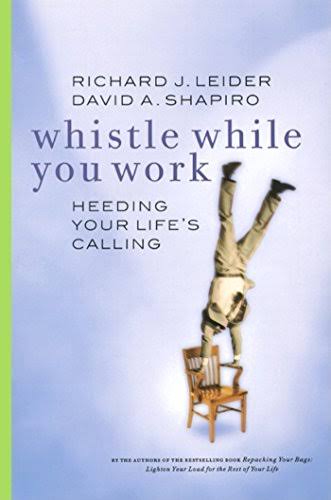
In “Whistle While You Work”, Richard J. Leider and David A. Shapiro argue that the real measure of success is not how much we accomplish, but how deeply we align what we do with who we are. Their central idea is timeless and urgent: meaning matters more than achievement.
They define calling as “the inner urge to give our gifts in service to something larger than ourselves.” That definition transforms the way we think about work. Purpose, they say, is not a luxury for the lucky few — it’s the fuel that sustains motivation, creativity, and resilience.
When our daily work expresses our values and talents, it energizes us. When it doesn’t, even the most prestigious position can leave us feeling strangely hollow. Leider writes, “We can be busy and bored at the same time if our work doesn’t connect to our purpose.”
The Three Questions of Purpose
Leider and Shapiro reduce the search for calling to three deceptively simple but profound questions:
- Who am I?
- What do I care about?
- Where is my place in the world?
The first is about identity — understanding the unique combination of strengths, values, and temperament that defines us. The second is about motivation — the causes, people, or principles that stir our energy and sense of duty. The third is about contribution — where our gifts can best serve others.
“Purpose,” they write, “is the place where your deep gladness meets the world’s deep need.”
I’ve come to see these three questions as a kind of inner compass — one that helps us navigate not just our careers, but the seasons of our lives. Without them, we risk walking briskly in the wrong direction: successful perhaps, but not fulfilled.
When Work Loses Its Music
I remember a time, years into my banking career, when I began to sense that the music of my work was fading. The tempo was still there — meetings, deals, travel, performance targets — but something essential had gone missing: the melody of meaning.
Like many leaders, I had learned to conduct the orchestra of business with precision, but I had stopped listening to the song itself.
That realization came quietly, not as a crisis but as clarity. I decided to step back — to relinquish the CEO role and remain as non-executive chairman. It wasn’t a retreat from responsibility; it was a return to reflection.
Leider and Shapiro might call this a “pause for purpose” — those moments when life invites us to stop chasing success long enough to rediscover significance. As they put it, “Sometimes you have to slow down long enough to hear what your life is trying to tell you.”
That pause allowed me to reconnect with what had first drawn me to leadership: the opportunity to build, mentor, and make things work better — not only systems, but people’s potential.
Purpose Is Not Found — It’s Practiced
One of the book’s most powerful insights is that purpose is not discovered once and for all; it is practiced daily.
Leider writes, “Calling is not a destination; it’s a direction.” It’s not about changing jobs but how we relate to what we already do.
That distinction matters enormously for leaders. Too often, we chase passion as if it were a hidden treasure waiting to be found. In reality, calling is cultivated through attention — by bringing presence, gratitude, and intention to the work before us.
In my own case, after stepping back from executive life, I began to write, teach, and mentor young leaders. It wasn’t a career change so much as a continuation of the same calling, expressed in a different key. The melody returned — quieter perhaps, but deeper.
The Leader’s Task: Reignite Meaning
Leider and Shapiro remind us that people don’t simply want to be managed — they want to be inspired. They want to see how their daily efforts contribute to something larger. “Purpose,” they write, “is the hidden driver of excellence.”
That’s why leadership, at its best, is not about control but connection — about helping others see the significance of their contribution. Great leaders don’t just assign tasks; they awaken meaning.
In my years leading banks, I learned that performance improves most when people understand why their work matters. When employees see the link between their role and the larger mission, they begin to “whistle while they work.” They don’t need constant supervision; they bring their own energy.
Leadership, then, is not merely strategic — it’s profoundly human. It’s about helping people align their gifts with purpose, and their purpose with the organization’s vision.
Reclaiming the Joy of Work
What I find most inspiring in “Whistle While You Work” is its humility. It doesn’t promise instant transformation. It offers something subtler: a quiet, persistent invitation to reclaim the joy of work by listening inward. “You don’t have to change jobs to do meaningful work,” the authors remind us. “You only need to change your relationship to your work.”
Meaning is not hidden in the next promotion, the next startup, or the next reinvention. It resides in how we show up — with curiosity, compassion, and integrity — wherever we are.
There’s a kind of wisdom in that simplicity. The real revolution is not in quitting but in reclaiming — seeing our work as a form of service, a chance to contribute, a place where our deepest values can be lived, not just admired.
After decades in leadership, I’ve realized that purpose doesn’t make work easier; it makes it worth doing. And when we find that sense of worth, we begin to hear the music again — and yes, we may even start to whistle while we work.
If you’d like to explore the book yourself, you can find it here on Amazon.
As an Amazon Associate, I earn from qualifying purchases. This means that if you click on a link in this post and make a purchase, I may receive a small commission, at no extra cost to you. Your support helps keep The Chairman’s Playbook going, and I’m grateful for it.
Leave a Reply