
“Leadership is an activity, not a position.”
On 4 January 1990, less than two weeks after Romania’s communist regime fell, I was appointed Deputy CEO and Deputy Chairman of the Romanian Foreign Trade Bank.
The appointment changed my position overnight. People who had been my colleagues — and those who had been my superiors — now reported to me. I had authority. What I lacked was a reliable map for what came next.
The country, the economy and the bank were all changing. None of us fully understood what the new system would require. Much of our experience belonged to a world that had just disappeared.
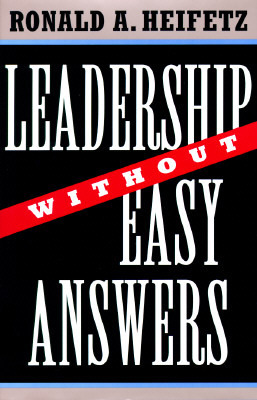
Years later, when I read Ronald Heifetz’s “Leadership Without Easy Answers, ” I recognized the situation immediately. Heifetz offered me words for something I had learned the hard way: people can confer authority in a day. Leadership cannot.
Leadership and Authority Are Not the Same
Most people still associate leadership with position. The chief executive leads the company. A minister leads the ministry. The general leads the army.
Sometimes they do. Sometimes they merely occupy the office.
Authority is necessary. It allows someone to decide, settle disputes, and provide order. But Heifetz asks us to separate it from leadership. They overlap, but they are not the same activity.
Leadership begins when familiar answers stop working — when people must face a reality for which their experience, rules and institutions are no longer sufficient.
Leadership can come from the top, the middle, or the edge of an organization. The person who asks the question everyone is avoiding may exercise more leadership than the person in the largest office.
Not All Problems Can Be Solved by Experts
Heifetz’s best-known distinction is between technical problems and adaptive challenges.
A technical problem may be extremely difficult, but someone knows how to address it. Operating is something a surgeon can do. A banker can redesign a control procedure. Expertise matters, and they can assign someone to do the work.
An adaptive challenge is more unsettling. No established solution is waiting to be applied. People must learn, change their behavior, and reconsider old assumptions. Something valued may have to be surrendered.
Heifetz describes these as “problems for which there are no simple, painless solutions.”
In 1990, many problems facing our bank appeared technical. We needed new procedures, products and relationships with foreign banks. We could bring in advisers and study Western banking models.
But beneath those tasks were harder questions. What did professional responsibility mean after decades of political control? How could people accustomed to following instructions learn to exercise judgment? Which habits remained useful, and which belonged to the system we were trying to leave behind?
No foreign adviser could answer those questions for us.
The Seduction of the Quick Answer
When people feel uncertain, they look towards whoever is in charge. They want reassurance. They want a decision. Above all, they want the discomfort to end.
The person in authority feels that pressure. I certainly did. Offering an answer creates movement and gives the impression of control. In a crisis, that can be irresistible.
But movement is not always progress.
Looking back, I can see occasions when I treated an adaptive challenge as a technical problem because the response was available. Someone could issue an instruction. Someone could alter a reporting line. They could appoint a specialist. These actions were visible. The deeper work was slower and less comfortable.
Heifetz defines leadership as “mobilizing people to tackle tough problems.” The wording matters. The leader does not take the problem away from people. He helps them face it and creates the conditions for them to work through it themselves.
Keeping People in the Difficult Conversation
Heifetz describes those conditions as a “holding environment” — a space where people can contain uncertainty and disagreement without suppressing them.
If the pressure is too low, people avoid the issue and return to familiar routines. If it is too high, they become defensive or search for someone to blame.
The task is to keep the pressure within a range people can tolerate without allowing them to escape the work.
I find this one of Heifetz’s most useful insights. We often imagine that a good leader reduces tension. Sometimes that is true. Other times, reducing tension too quickly protects the very behavior that needs to change.
A hard question may need to remain open longer than anyone finds comfortable.
Why Leadership Becomes Dangerous
Heifetz writes that “leadership is dangerous.” He is not being dramatic. Adaptive change usually brings loss.
People may lose status, confidence, familiar relationships, or a way of working they once felt competent in. Even beneficial change can threaten identity. Resistance is not always ignorance or stubbornness. Sometimes people understand the change perfectly well — and understand what it will cost them.
Those who raise uncomfortable questions often become the target of the discomfort. Organizations distract themselves, attack the messenger, or promote a reassuring explanation. I have seen all three.
Exercising leadership requires courage and restraint. One must disturb the system enough to make learning possible without pushing it beyond its ability to respond — and protect voices carrying information authority does not want to hear.
The Courage to Say, “I Don’t Know”
“Leadership Without Easy Answers” remains a powerful book because it asks leaders for more than confidence and decisiveness. It asks them to recognize the limits of their own knowledge.
The most honest words a leader can sometimes say are: “I don’t know.”
But they cannot be the last words. An invitation must follow them: “Let us face the facts together. Let us discover what must change. Let us do the work that no expert, adviser, or person in authority can do for us.”
That is not a failure of leadership
It is often where leadership begins.
If you’re interested in exploring this book further, you can find it available here on Amazon.
As an Amazon Associate, I earn commissions from qualifying purchases linked in this post without additional costs to readers – thank you for supporting the endeavors behind ‘The Chairman’s Playbook’!
Leave a Reply