
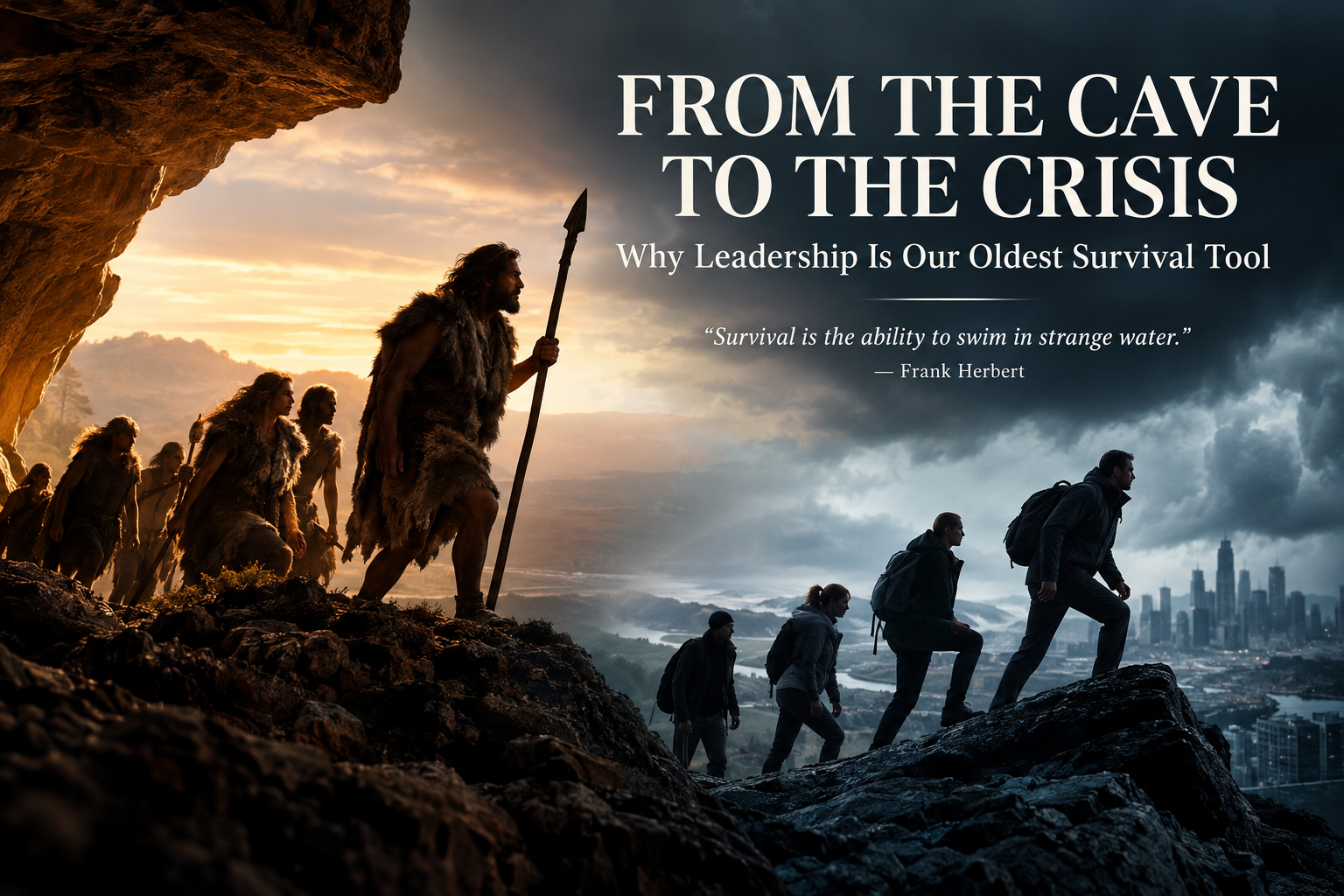
“Survival is the ability to swim in strange water.” — Frank Herbert
Leadership for survival
Before leadership became a profession, a field of study, or a shelf of books, it was something much more fundamental.
It was a means of survival.
Imagine our distant ancestors leaving the relative protection of their caves. Beyond them lay opportunity — food, water, fresh territory — but also predators, hostile groups, storms, injury, and uncertainty.
No individual could reliably survive alone. People had to hunt together, protect one another, share information, decide when to move and when to stay, and respond collectively when danger appeared.
Someone had to notice what others had not noticed. It was necessary for someone to say, “We should go this way.” Someone had to persuade others to follow.
Leadership existed long before we had a word for it.
And its original purpose was not status.
It was survival.
When the Map No Longer Works
This helps explain why leadership becomes most visible in a crisis.
During normal times, habit, rules, and established institutions can govern much of life. We know approximately what tomorrow will look like because it resembles yesterday.
Crisis breaks continuity.
Suddenly, the old map no longer describes the territory.
The hunting grounds have disappeared. The enemy has crossed the border. The ship is stuck in the ice. A bank is running out of liquidity. A pandemic closes borders. A technology threatens an entire industry.
And people ask the ancient questions:
“What is happening?” “What should we do?” “Whom should we trust?”
This is where leadership becomes indispensable.
Not because leaders know the answers. Often they do not. Leadership matters because someone must help a group confront reality, interpret uncertainty, make choices before all the facts are available, and turn frightened individuals into coordinated action.
That is as true in a boardroom as it was around a prehistoric fire.
Shackleton: Survival Before Glory
Few stories illustrate this better than Ernest Shackleton.
When his ship Endurance became trapped and eventually crushed by Antarctic ice, his expedition’s objective changed completely.
The original mission was over. Success could no longer mean crossing Antarctica. It meant bringing his men home alive.
Shackleton understood something fundamental about crisis leadership: when circumstances change radically, leaders must redefine success.
He maintained routines, watched morale, managed tensions, and projected confidence without pretending conditions were safe. After an extraordinary sequence of journeys across ice and open ocean, every member of the Endurance expedition survived.
Leadership had returned to its most elemental purpose: holding a group together through danger.
Churchill and the Leadership of Defiance
An even greater test came in Britain in 1940.
France was collapsing. Much of Europe was falling under Nazi domination. Britain faced the possibility of invasion. Winston Churchill could promise neither safety nor quick victory.
His first responsibility was not to reassure people with comforting illusions. It was to tell them the truth.
When he became prime minister, he told Parliament:
“I have nothing to offer but blood, toil, tears, and sweat.”
Weeks later, after Dunkirk, he promised that Britain would fight “on the beaches” and “in the fields and in the streets.”
Those words were powerful not because of optimism. Churchill made the danger explicit — and then gave people a way to stand against it.
In a crisis, people do not need leaders who tell them everything will be fine. They need leaders who make reality bearable by making purposeful action possible.
Churchill could not remove fear. He could convert fear into resolve.
That may be one of leadership’s oldest functions.
The Crisis I Recognize
I have encountered this on a vastly smaller scale in business.
During financial crises, I learned how quickly the atmosphere inside an organization can change. Assumptions that seemed secure yesterday become doubtful. Rumors multiply. People watch one another for signals. Anxiety can travel through an institution faster than facts.
In moments like these, leadership is not primarily about charisma.
People look at the leader and ask, often without saying it: “Do you understand what is happening?” “Are you telling us the truth?” “Is there a plan?” “Do you believe we can get through this?”
The leader cannot manufacture certainty where none exists.
But the leader can create clarity.
And clarity makes coordinated action possible.
The Ancient Function Remains
Our dangers have changed enormously since humanity emerged from caves. Today we confront financial contagion, pandemics, wars, technological disruption, cyberattacks, and environmental shocks.
Yet our reactions to danger have changed much less.
We become afraid. Fear narrows our attention. We seek certainty. We protect ourselves. Fragmentation can occur when cooperation is most necessary.
That is why leadership remains essential.
Its deepest function is not commanding people.
It enables people to act together when circumstances tempt them to fall apart.
The leader helps a group see reality without surrendering to it, preserve trust when fear corrodes it, choose when certainty is impossible, and maintain enough common purpose to keep moving.
And leadership need not come only from the top. In crisis, it can emerge from a doctor in an emergency room, a manager preserving a team, a parent reassuring a family, or an ordinary person who acts while others hesitate.
The title is secondary.
The function is ancient.
From Survival to Possibility
Leadership today, however, should do more than help us survive.
Once the immediate danger has passed, the leader must ask: “What have we learned, and what should become different because of it?”
Survival without learning merely prepares us to repeat the same crisis.
The best leaders take people through danger and leave them more capable than before.
Around the first fires, leadership helped human beings survive the night. Across centuries, it helped communities survive famine, migration, war, and disaster.
Today, at its best, leadership still performs that ancient function — but adds another.
It helps us cross the crisis, learn from it, and turn survival into renewed possibility.
When the familiar world disappears, and we find ourselves, in Frank Herbert’s wonderful phrase, swimming in strange water, we still look for leadership.
Not for someone who can guarantee that we will survive.
But for someone who can help us survive together.
Questions for Reflection
- When have you seen a group become more dependent on leadership because the familiar rules no longer worked?
- In a crisis, what do people need first from a leader: truth, reassurance, direction, action – or something else?
- How well do you distinguish between creating clarity and pretending to have certainty?
Download the Chairman’s Playbook Worksheet — Play 53: Why Leadership is Humanity’s Survival Tool
📚Further Reading
- Winston S. Churchill — The Second World War
Especially the early volumes. It connects directly with your Churchill section: confronting brutal reality while sustaining collective resolve. - Ernest Shackleton — South
The natural companion to your Shackleton passage. Leadership stripped to its essentials: adaptability, morale, responsibility, and bringing people home alive. - Alfred Lansing — Endurance: Shackleton’s Incredible Voyage
Probably the most compelling narrative version of the Endurance story. Particularly relevant to your idea that crises force leaders to redefine success. - John F. Kennedy — Profiles in Courage
Less about physical survival and more about the courage required to lead when conviction, reputation, and political survival are at stake. - Ronald Heifetz, Alexander Grashow & Marty Linsky — The Practice of Adaptive Leadership
Strong conceptual support for your “when the map no longer works” section. Leadership becomes especially necessary when existing knowledge and routines cannot solve the problem.
As an Amazon Associate, I earn commissions from qualifying purchases linked in this post without additional costs to readers – thank you for supporting the endeavors behind ‘The Chairman’s Playbook’!
Leave a Reply