
“The servant-leader is servant first.”
The phrase servant leadership can sound almost contradictory.
We normally associate leadership with authority, direction, ambition, and power. A leader stands in front. A servant stands behind. One commands; the other serves.
Robert K. Greenleaf’s servant leadership challenged this assumption with a deceptively simple reversal:
What if the desire to serve comes before the desire to lead?
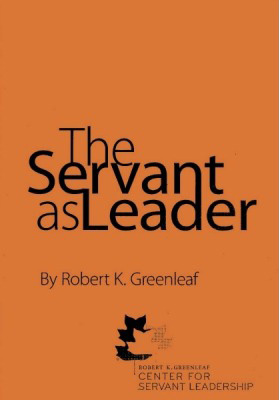
Greenleaf spent nearly four decades at AT&T, working in management, development, and organizational research. After leaving the company, he began writing about leadership and institutions. In 1970, he published “The Servant as Leader,” introducing an idea that would become one of the most influential alternatives to traditional command-and-control leadership.
His starting point was not a technique but a motivation:
“It begins with the natural feeling that one wants to serve, to serve first.”
Only afterward comes the conscious choice to lead.
That sequence matters.
Servant Leadership: The Test of Leadership
Greenleaf did not leave servant leadership as an attractive philosophy. He gave us a demanding test:
“Do those served grow as persons?”
“Do they become wiser, freer, more autonomous and more likely themselves to become servants?”
This moves the measurement of leadership away from the leader and towards the consequences of leadership for others.
Leadership easily becomes self-referential. We ask whether I am influential, whether my vision is compelling, whether my team performs, whether my strategy succeeds.
Greenleaf asks us to turn the telescope around.
“What are the people around me becoming because I lead them?”
That may be one of the most important questions any leader can ask.
Servant Leadership Is Not Weak Leadership
The word servant can create the wrong impression.
A servant leader is not someone who avoids tough decisions, tries to please everybody, tolerates poor performance, or abdicates authority.
Service is not submission.
Leadership still requires judgment. It requires standards, courage, accountability, and sometimes decisions that disappoint people. A CEO who refuses to confront failure because confrontation feels uncomfortable is not serving employees, shareholders, customers, or the institution.
Greenleaf himself recognized the importance of initiative:
“The servant always accepts and empathizes, never rejects.”
Acceptance, however, does not mean agreement. We can respect the person while challenging the behavior. We can listen carefully and still decide differently.
The distinction lies in the purpose that drives the exercise of power.
The conventional leader may ask:
“How can people help me accomplish my objectives?”
The servant leader asks:
“How can I use my authority to help us accomplish a worthy purpose — and enable people to grow while doing so?”
Authority remains. Its moral direction changes.
Power Becomes Stewardship
This leads to something larger than kindness.
Servant leadership is fundamentally a philosophy of power.
Every leadership position gives us temporary control over things that do not entirely belong to us: institutions, reputations, resources, opportunities, and the working lives of other people.
We can treat these as possessions.
Or we can treat them as things entrusted to us.
The second attitude is stewardship.
I have occupied leadership positions for much of my professional life, and experience has made me increasingly skeptical of the idea that an organization “belongs” to its current leaders. We inherit something created by others. We influence it for a period. Eventually, we hand it to someone else.
The question is therefore not simply:
“What did I achieve while I was here?”
It is also:
“What did I leave behind?”
Did I leave stronger people? Better judgment? Greater confidence? More capable successors? An institution less dependent on me?
Greenleaf captured the developmental responsibility of leadership in another memorable phrase:
“The secret of institution building is to be able to weld a team of such people.”
Leadership, in this sense, is not merely achieving through people. It is increasing people’s capacity to achieve without us.
Servant Leadership and the Paradox of Making Yourself Less Necessary
Many leaders unconsciously make themselves indispensable.
They remain at the center of decisions. Information flows upwards. Approval flows downwards. Their judgment gradually replaces the judgment of others.
It can look like strong leadership.
Often, it is institutional weakness disguised as personal competence.
The servant leader should move in the opposite direction.
Teach people to decide. Give them responsibility before they feel completely ready. Allow recoverable mistakes. Share context rather than merely issuing instructions. Develop judgment rather than demanding obedience.
Create successors rather than followers.
That’s why Greenleaf’s test is so radical. The aim is not to produce better followers. It is to help create people who are “more autonomous” and “more likely themselves to become servants.”
The ultimate achievement of leadership therefore contains a paradox:
The better you lead, the less the organization should need you.
Listening Before Speaking
Greenleaf also placed unusual emphasis on listening.
“A true natural servant automatically responds to any problem by listening first.”
Traditional leadership often celebrates the person with the answer. Greenleaf valued the leader who could hear the question not yet properly articulated.
Listening is not passive.
It requires enough confidence to suspend one’s own certainty. Hierarchy gives leaders authority; it does not give them superior access to reality.
People closer to customers, technology, operations, or emerging problems often see things earlier than those at the top.
A leader who cannot listen eventually leads an organization that cannot see.
Leadership as an Obligation to Others
I would not make servant leadership the complete theory of leadership. Leaders must also provide direction, exercise judgment, confront reality, and sometimes act decisively before consensus exists.
But Greenleaf contributes something indispensable.
He reminds us that leadership cannot finally be judged by the privileges it confers upon the leader.
One must judge it by what the leader does with them.
Leadership gives us influence over people we do not own, authority that will eventually pass to someone else, and responsibility for institutions whose lives may extend beyond ours.
That makes leadership less a possession than a trust.
Greenleaf’s “best test” therefore leaves every leader with an uncomfortable but valuable question.
Not:
“How many people follow me?”
Nor even:
“How much have I achieved?”
But:
“Are the people and institutions I serve becoming more capable because I led them?”
If they are becoming wiser, freer, stronger, and more capable of serving others, leadership has achieved something greater than performance.
It has multiplied capacity.
If you’re interested in exploring this book further, you can find it available here on Amazon.
As an Amazon Associate, I earn commissions from qualifying purchases linked in this post without additional costs to readers – thank you for supporting the endeavors behind ‘The Chairman’s Playbook’!
Leave a Reply