
When Leadership Becomes More Than Power
“One of the most universal cravings of our time is a hunger for compelling and creative leadership.”
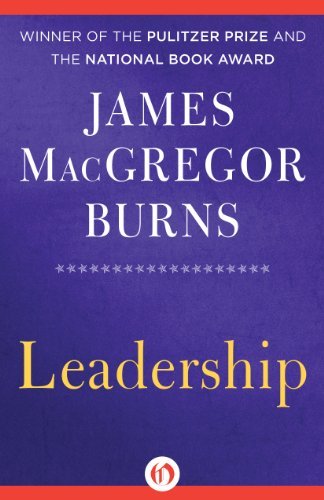
With that observation, James MacGregor Burns opens “Leadership,” published in 1978. Nearly half a century later, the hunger has hardly disappeared.
We still search for leaders whenever institutions falter, companies lose direction, governments disappoint, or societies confront uncertainty. We look for someone with vision, courage, and the ability to act.
But Burns asks a more difficult question: “What actually is leadership?”
His answer transformed the study of the subject.
Power Is Not Leadership
Burns begins by separating two ideas we constantly confuse: power and leadership.
A president, chief executive, general, or chairman possesses authority. He or she can allocate resources, appoint people, reward performance, and impose consequences. But authority alone does not make someone a leader.
For Burns, leadership is relational. It exists between leaders and followers, whose purposes and motivations matter too.
His definition is demanding:
“Leadership over human beings is exercised when persons with certain motives and purposes mobilize… resources to arouse, engage, and satisfy the motives of followers.”
Leadership, therefore, is not something one person does to other people.
This distinction corresponds closely to what I have observed throughout my professional life. I have known people with considerable formal authority who were excellent leaders, and others who possessed power without truly leading.
The difference often becomes clearest when the title disappears.
An institution confers authority. Leadership has to be earned in a relationship.
Transactional Leadership
Burns distinguished between two fundamentally different forms of leadership.
The first is transactional leadership.
The principle is familiar: I give you something you value, and you give me something I value.
A politician offers policies for votes. For performance, a manager might offer compensation or a promotion. A chairman negotiates support for a decision by accommodating different interests.
There is nothing inherently wrong with this. Organizations could hardly function without transactions. Organizations must define responsibilities, honor commitments, and reward performance.
But transactions have limits.
A leader can run an efficient organization while leaving the people within it essentially unchanged. The organization achieves targets, pays bonuses, and executes strategies.
The machine works.
But nothing deeper happens.
Transforming Leadership
Burns’s substantial contribution was his second category: transforming leadership.
Here, the relationship between leader and followers changes.
As Burns famously wrote:
“Leaders and followers raise one another to higher levels of motivation and morality.”
That single sentence contains much of the power of the book.
The leader is no longer asking only:
“How can I get people to do what needs to be done?”
The deeper question becomes:
“What can we become together?”
Leadership is no longer principally about control. It becomes an act of enlarging collective possibility — helping people see purposes they had not previously seen, accept responsibilities they might otherwise have avoided, and achieve things none could accomplish alone.
The distinction has stayed with me because the best leaders I encountered did not merely get better performance from people.
They left people more capable than they found them.
Leadership Has a Moral Purpose
Another part of Burns often gets overlooked when people reduce “transformational leadership” to a management technique.
For Burns, leadership has a moral dimension.
We admire vision, decisiveness, courage, communication, and charisma. But those qualities tell us surprisingly little about whether someone is exercising good leadership.
A person can mobilize thousands toward destructive purposes.
Effectiveness alone is therefore insufficient.
We must always ask:
“Effective for what?”
That question becomes increasingly important as leaders gain greater technological, financial, and organizational power.
Capability without purpose can become dangerous.
Leadership Does Not Belong Only to the Leader
Perhaps Burns’s most important insight is that leadership does not reside entirely in the person at the top.
Followers have agency.
Leadership happens between people.
This challenges the heroic image that has dominated our imagination for centuries: the exceptional individual standing above the crowd, seeing farther, deciding faster, and moving history through force of personality.
In organizations, I have often seen the danger of this model.
A chief executive surrounded by passive executives may appear powerful while presiding over a weak leadership system. Although a chairperson who controls all discussions can make rapid decisions, this may progressively erode the board’s capacity for sound judgment. A founder who decides everything may create an impressive company that cannot survive without him.
There is a paradox here:
The more indispensable leaders make themselves, the less leadership capacity they may leave behind.
From Great Leaders to Capable Collectives
This is where Burns seems especially relevant today.
Many of our most intractable problems exceed the capacity of any individual leader. A single brilliant person cannot navigate artificial intelligence, geopolitical fragmentation, demographic change, technological disruption, and, at the top of a hierarchy.
Knowledge is distributed. Judgment benefits from unique experiences. Action requires cooperation. Learning must survive leadership changes.
So perhaps the question of our century is gradually changing.
Instead of asking only:
“Who is the right leader?”
We should also ask:
“How do we create collectives capable of leading?”
What I Took From Burns
I spent much of my professional life in positions where people expected decisions. When you occupy the chair, somebody eventually has to decide, and sometimes quickly.
I still believe that.
But experience taught me that the deeper test of leadership comes later.
“What remains when you are gone?”
Can people exercise judgment without you? Is it possible for them to disagree productively? Can an institution learn? Is it capable of adapting without waiting for instructions from the top? Can the next generation inherit not merely procedures, but the capacity to think and act responsibly?
Burns helped give us a language for asking these questions.
Leadership is not synonymous with position, power, or charisma.
Its ultimate legacy may therefore be measured not by how many followers a leader accumulated, but by something much harder:
How many people became more capable because that leader was there.
If you’re interested in exploring this book further, you can find it available here on Amazon.
As an Amazon Associate, I earn commissions from qualifying purchases linked in this post without additional costs to readers – thank you for supporting the endeavors behind ‘The Chairman’s Playbook’!
Leave a Reply