
Why Knowing Isn’t Enough
“Intelligence is not only about what you know. It is also about how effectively you use what you know.” — Robert J. Sternberg
We admire intelligence that is easy to measure — high IQs, top grades, prestigious universities, and impressive technical expertise — all signal intellectual ability. Yet, in organizations, the people who consistently solve problems, earn trust, and get things done are not always the smartest in the traditional sense.
They possess something different: practical intelligence.
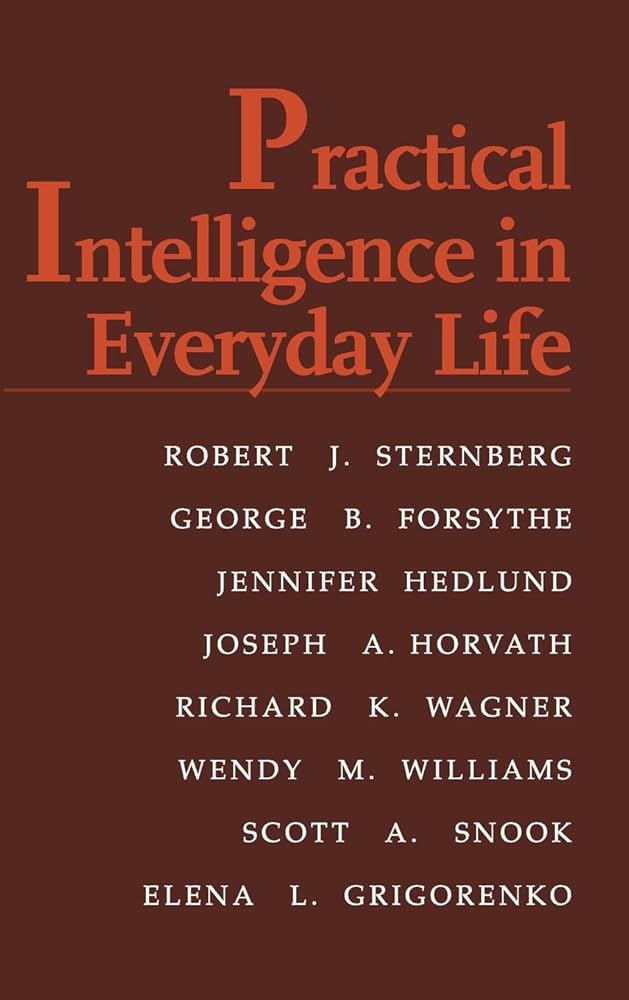
In “Practical Intelligence in Everyday Life,” Robert J. Sternberg and Elena L. Grigorenko argue that success depends not only on analytical intelligence but also on the ability to apply knowledge effectively in real-life situations. Practical intelligence is the bridge between knowing and doing. It is what transforms expertise into results.
For leaders, this distinction is crucial.
Beyond IQ
Traditional intelligence tests measure reasoning, memory, and analytical ability. These skills matter, but leadership presents problems that rarely have a single correct answer.
A leader may know every financial ratio yet cannot persuade a board.
An engineer may design brilliant products but struggle to lead a team.
An executive may understand strategy perfectly but misread the organization’s culture.
Knowledge alone does not guarantee effective action.
Sternberg describes practical intelligence as “knowing how.” People often gain it through experience rather than formal education. It enables people to adapt, influence, negotiate, judge situations, and make sound decisions despite uncertainty.
In leadership, these abilities frequently matter more than technical brilliance.
The Difference Between Experts and Effective Leaders
Throughout my banking career, I met exceptionally intelligent specialists.
Some became outstanding leaders.
Others remained outstanding specialists.
The difference was rarely their technical competence. Instead, it was their ability to navigate people, organizations, and ambiguity.
The best leaders sensed when data was incomplete, but a decision could not wait.
They knew which battles deserved attention.
They understood how to convince rather than command.
They recognized when a technically correct solution would fail because it ignored human realities.
Those are expressions of practical intelligence.
Tacit Knowledge: The Invisible Advantage
One of the book’s most valuable ideas is tacit knowledge.
Tacit knowledge comprises lessons that are rarely written down . People learn tacit knowledge through observation, reflection, mistakes, and experience.
No manual explains exactly how to earn credibility after making a mistake.
No MBA course fully teaches how to calm a frightened organization during a crisis.
No textbook can tell you the precise moment when listening becomes more powerful than speaking.
These lessons accumulate over the years.
Experienced leaders often find it difficult to explain how they reached their conclusions because much of their judgment comes from tacit knowledge built over thousands of situations.
Therefore, experience matters — but only if we learn from it.
Twenty years of repeating the same habits does not create wisdom.
Twenty years of thoughtful reflection might.
Leadership Is Pattern Recognition
Practical intelligence is closely connected to pattern recognition.
The more situations leaders encounter, the more they recognize familiar dynamics beneath seemingly distinct problems.
A disagreement between departments may actually be about incentives rather than personalities.
Declining morale may reflect uncertainty rather than poor motivation.
Resistance to change may stem from fear rather than stubbornness.
Leaders with practical intelligence look beneath symptoms to identify underlying causes.
They develop what others call “good judgment.”
In reality, judgment is often an accumulated pattern recognition.
Adapting Matters More Than Knowing
One of Sternberg’s broader theories describes successful intelligence as the ability to adapt to, shape, or select environments.
Leadership demands exactly these three capabilities.
Sometimes we adapt to difficult circumstances.
Sometimes we reshape those circumstances through vision and action.
Sometimes we recognize that the environment itself is wrong and choose another path.
Great leaders know which response fits each situation.
Less effective leaders apply the same solution everywhere.
A hammer sees every problem as a nail.
Practical intelligence knows when to use a different tool.
Why Smart People Sometimes Fail
Organizations are full of highly educated people who struggle to lead.
Not because they lack intelligence.
Because they overestimate analytical thinking and underestimate practical judgment.
Common traps include:
- Mistaking expertise for leadership.
- Assuming logic alone persuades people.
- Ignoring organizational politics.
- Underestimating emotions.
- Believing experience automatically creates wisdom.
Leadership requires all of these dimensions.
As Sternberg reminds us, intelligence is multidimensional.
Analytical intelligence explains.
Creative intelligence imagines.
Practical intelligence delivers.
The strongest leaders develop all three.
Can Practical Intelligence Be Learned?
This is perhaps the most encouraging message in the book.
Unlike IQ, practical intelligence grows through deliberate experience.
Every difficult conversation becomes a lesson.
Every failed project becomes feedback.
Every negotiation improves judgment.
Every crisis strengthens pattern recognition.
The key is reflection.
Experience without reflection produces repetition.
Reflection transforms experience into practical intelligence.
Throughout my career, some of my greatest lessons came not from successes but from failures — projects that disappointed, decisions that proved incomplete, or opportunities I misunderstood. Those moments became valuable only because I later examined them honestly.
Failure teaches little.
Reflected failure teaches a great deal.
Five Ways Leaders Can Develop Practical Intelligence
The authors’ work suggests several habits leaders should cultivate.
1. Seek experiences outside your comfort zone. Growth happens where familiar routines end.
2. Observe experienced leaders. They do not explicitly teach many of their most valuable skills.
3. Ask after every major decision: “What worked?” “What surprised me?” “What would I do differently next time?”
4. Spend time understanding people, not just processes. Leadership is ultimately a human activity.
5. Remain intellectually humble. Practical intelligence grows when curiosity replaces certainty.
The leaders who stop learning eventually stop leading.
The Leadership Lesson
Organizations often promote people because they are technically outstanding.
They remain successful only if they also become practically intelligent.
Knowledge opens doors.
Practical intelligence keeps them open.
In a world increasingly shaped by artificial intelligence, this distinction becomes even more important. Machines can process information faster than any human. They can summarize reports, detect patterns in enormous datasets, and recommend options within seconds.
What they cannot easily replicate is the practical wisdom that comes from lived experience, ethical judgment, contextual understanding, and deep human relationships.
Leadership has never been simply about knowing the answer.
It has always been about knowing what to do, with whom, when, and why.
That is practical intelligence.
And perhaps it is becoming one of the most valuable forms of intelligence a leader can possess.
If you’re interested in exploring this book further, you can find it available here on Amazon.
As an Amazon Associate, I earn commissions from qualifying purchases linked in this post without additional costs to readers – thank you for supporting the endeavors behind ‘The Chairman’s Playbook’!
Leave a Reply