
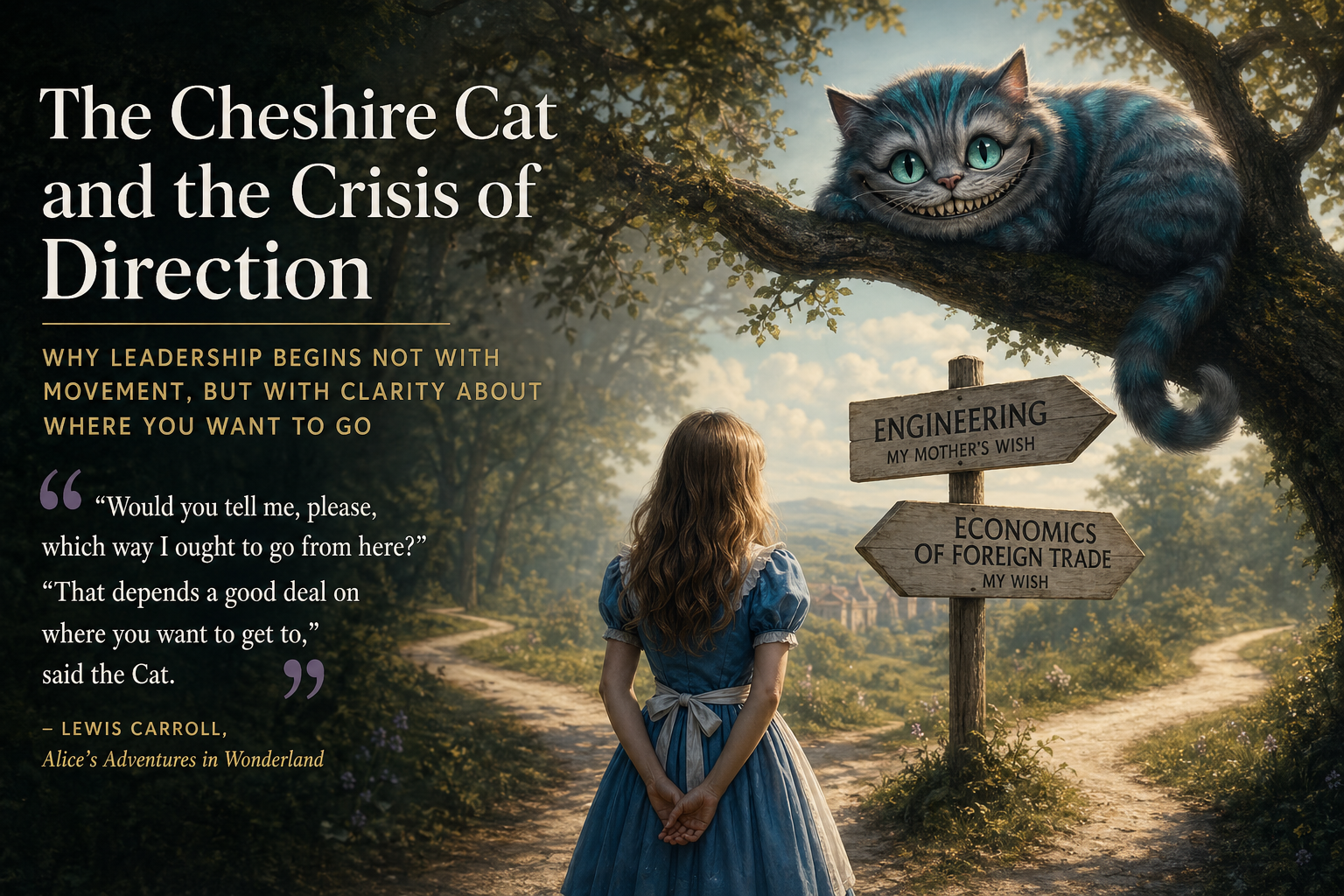
Why leadership begins not with movement, but with clarity about where you want to go
“If a man knows not to which port he sails, no wind is favorable.” — Seneca
As a child, I loved “Alice in Wonderland”. Its absurdity, its imagination, and its unforgettable characters charmed me. But like many children, I enjoyed the story without fully understanding the meaning of its most famous exchange.
Only much later did I grasp its wisdom — when I had to choose what I wanted to study at university.
The choice was between engineering, which was my mother’s wish for me, and economics of foreign trade, which was my own. The decision felt both practical and personal. But beneath it lay a larger question, one that many people face far beyond youth: not simply “Which way should I go?” but “Where do I want to get to?”
That is why this brief dialogue between Alice and the Cheshire Cat has stayed with me for so long:
“Would you tell me, please, which way I ought to go from here?”
“That depends a good deal on where you want to get to,” said the Cat.
“I don’t much care where,“ said Alice.
“Then it doesn’t matter which way you go,” said the Cat.
“So long as I get SOMEWHERE,” Alice added as an explanation.
“Oh, you’re sure to do that,” said the Cat, “if you only walk long enough.”
Lewis Carroll’s dialogue offers one of the clearest lessons in leadership: if you do not know where you want to go, almost any path will seem acceptable.
That is true for individuals, teams, and institutions alike.
Why Direction Comes Before Action
Many leaders confuse motion with progress. They launch initiatives, hold meetings, revise structures, and make visible decisions. From the outside, this looks like leadership. But movement alone is not leadership. Action without direction creates noise, fatigue, and confusion more often than it creates meaningful results.
The Cheshire Cat exposes this problem with elegant simplicity. Alice wants guidance on which road to take, but she cannot clearly say where she wants to arrive. The Cat’s answer is devastatingly logical: if the destination is unclear, the route hardly matters.
That is not just a literary insight. It is a leadership principle.
In leadership, the first task is not speed. It is clarity.
Before deciding how to move, a leader must define where the organization, team, or individual is trying to go. “What are we trying to build?” “What matters most?” “What culture should we aim for?” “What are we not willing to compromise on?”
Without answers to those questions, effort becomes fragmented. People may work hard, but not necessarily in the same direction.
The Danger of Busy Leadership
I have seen many institutions fall into this trap. They were not inactive. They were full of activity. But activity without strategic clarity is often just a sophisticated form of wandering.
This is one of the great hidden risks in leadership. A team can be productive even when misdirected. A company can be efficient and still move toward the wrong future. A leader can appear decisive while avoiding the most important decision of all: defining the destination.
The Cheshire Cat’s point is that you will get somewhere if you walk long enough. That is true in business as in life. Time and effort will always produce some outcome. But “somewhere” is not the same as the right place.
Leadership is about reducing the gap between movement and meaning.
Why Strategic Clarity Matters
Strategic clarity is not a luxury reserved for boards and chief executives. It matters at every level.
A board without clarity becomes reactive.
A CEO without clarity multiplies priorities.
A manager without clarity confuses the team.
An individual without clarity becomes vulnerable to distraction, pressure, and fashion.
When people do not know what success looks like, they cannot align their choices. They respond to urgency rather than to purpose. Their frequency of saying yes is quite high. They mistake activity for contribution.
Clarity does not remove complexity, but it makes complexity navigable. Understanding the destination makes trade-offs easier. Decisions become more coherent. People understand not only what to do, but why it matters.
That is one of the most valuable things a leader can provide.
Leadership Means Choosing, Not Just Moving
There is another important insight in Alice’s dialogue. The real problem is not that she lacks options. The problem is that she lacks commitment.
Defining a destination forces a leader to leave alternatives behind. Clarity forces choice. It exposes priorities. It reveals what matters enough to pursue and what must be declined.
That is why many leaders remain vague. Vagueness feels safer. Flexibility is preserved. It delays judgment. It avoids disappointing people. But vague leadership creates uncertain organizations.
Clear leadership does the opposite. It creates alignment by providing people with a basis for judgment. They can test decisions against a stated direction. Distraction is recognizable when they think. They can coordinate around a shared aim.
Agility Without Direction Is Just Drift
Modern leadership often celebrates agility, responsiveness, and speed. Those qualities matter. But they are not enough.
Agility without direction is drift. Speed without purpose is waste. Adaptability without a clear aim becomes a series of reactions rather than a strategy.
The best leaders are not always the fastest-moving ones. They are often the clearest-thinking ones. They help others understand what matters, their destination, and what success means.
The Leadership Question Behind Every Crossroad
The Cheshire Cat reminds us that before asking, “Which way should we go?” leaders must ask a harder question:
“Where do we want to get to?”
Until that is answered, the rest is motion without meaning.
And in leadership, that is one of the costliest mistakes of all.
Questions for Reflection
- Where do I really want to get to in this season of life or leadership?
- 2. What decision am I avoiding because I am still unclear about the destination?
- 3. Where am I confusing movement with progress?
Download the Chairman’s Playbook Worksheet — Play 40: The Cheshire Cat and the Crisis of Direction
📚Further Reading
1. The Road Less Traveled — M. Scott Peck
A thoughtful exploration of discipline, growth, and the difficult choices required to build a meaningful life.
2. Designing Your Life — Bill Burnett and Dave Evans
A practical book that helps people think more intentionally about life and career choices instead of drifting into them.
3. Essentialism — Greg McKeown
A strong argument for clarity, focus, and choosing what matters most rather than being pulled in every direction.
4. The Path Made Clear — Oprah Winfrey
A collection of reflections on purpose, calling, and the inner clarity needed to choose a meaningful path.
5. The 7 Habits of Highly Effective People — Stephen R. Covey
A foundational leadership book that emphasizes beginning with the end in mind and aligning daily choices with deeper principles.
As an Amazon Associate, I earn commissions from qualifying purchases linked in this post without additional costs to readers – thank you for supporting the endeavors behind ‘The Chairman’s Playbook’!
Leave a Reply