
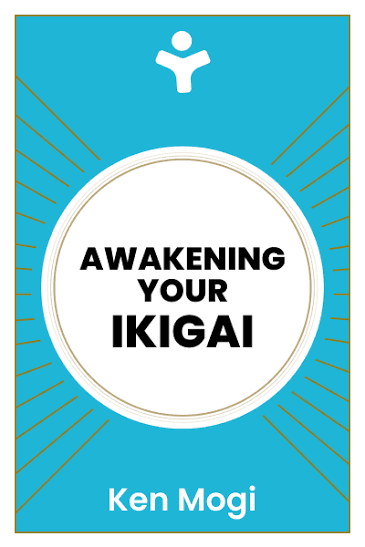
“Ikigai resides in the realm of small things.” — Ken Mogi, Awakening Your Ikigai
Most books about purpose begin with a grand question: What is your mission? Ken Mogi begins with something far more believable — your morning. In “Awakening Your Ikigai”, Mogi (a Japanese neuroscientist) argues that meaning is not something we “discover” once and then announce. It is something we practice: through tiny rituals, careful attention, and a grounded joy that endures ordinary days. Purpose, in his telling, is not a dramatic reinvention. It is a steady relationship with life.
That matters to leaders. Leadership rarely collapses from a lack of ambition; it collapses from slow depletion. Noise drains energy. Meaning gets diluted by politics. Roles, titles, and quarterly targets now define people’s identities. Ikigai, as Mogi frames it, is an antidote — not because it is sentimental, but because it is stabilizing. It re-centers you on what is sustainable, repeatable, and real.
The book is quietly skeptical of “grand frameworks.” Modern work loves motivational machinery: bold slogans, heroic narratives, and quarterly reinventions. Mogi suggests we rarely need a dramatic system to stay motivated; we need small practices we can actually live with. For leaders, that is a critique of performative purpose — when meaning becomes something we present rather than something we embody. It’s also a reminder that leaders cannot power their demanding lives solely with inspiration.
A second insight is liberating: ikigai is a spectrum. It can be big or small, public or private. Mogi writes about everyday sources of meaning — “the morning air,” “the cup of coffee,” “the ray of sunshine.” If your meaning depends only on major wins — promotions, exits, applause — you become fragile. You need constant external proof to feel whole on the inside. Ikigai, in this sense, is the meaning that survives ordinary days.
This is where the book quietly touches the modern executive condition: you can be busy, successful, and still feel empty. Not because you lack gratitude, but because urgent demands that never end have captured your attention. Ikigai restores proportion. It lets you be serious about results while staying loyal to the small experiences that keep you human.
Mogi is known for his five pillars of ikigai: starting small, releasing yourself, harmony and sustainability, the joy of little things, and being in the here and now. Read as leadership disciplines, they form a practical operating system.
1) Start small: excellence is made of details
Starting small is not thinking small. It is building momentum through manageable steps and craft. Culture shifts in millimeters. Don’t “improve culture” — change one meeting ritual. Don’t “increase accountability” — redesign one handoff. Build one habit your team can repeat even on a hard week. Small steps become identity. Identity becomes culture.
2) Release yourself: loosen the grip of ego
Leadership is often portrayed as certainty. But high-quality leadership is the ability to remain open — especially when your status would prefer you to close.
It is Mogi’s reminder that ego is expensive. It turns feedback into a threat and other people’s talent into competition. When you feel defensive, replace defense with curiosity: “What might I be missing?” Then make one visible change. A leader who can learn in public becomes safer to follow.
3) Harmony and sustainability: don’t win in ways that poison the system
Ikigai is not only personal; it is relational. Mogi captures this with images that fit leadership: “A man is like a forest; individual and yet connected,” and “dependent on others for growth.” Organizations are ecosystems. Sustainability shows up in daily trade-offs: speed versus burnout, results versus ethics, ambition versus organizational health. Short-term wins that damage trust are loans with brutal interest. Harmony does not mean avoiding conflict; it means resolving conflict in a way that improves the system.
4) The joy of little things: the neglected fuel source
Many leaders run on urgency. Urgency can power action, but it rarely powers meaning. Mogi’s focus on small joys is a reminder that leadership requires fuel that doesn’t burn people out. Attention shapes culture. What you notice and name becomes what your team believes matters. Once a week, publicly name one “small excellence” you noticed — an extra step, a clean handoff, a thoughtful decision. This trains the organization to see craft, not just outcomes.
5) Be in the here and now: presence is a competitive advantage
In actual organizations, attention is fragmented: devices, messages, meetings, and the inner noise of worry. Presence is not spiritual decoration. It is operational. When you are truly present, you hear what people mean, not only what they say. You detect weak signals earlier. You make fewer reactive decisions. In a fast world, presence is a serious advantage — and it is one you can practice.
The book’s most useful implication is that ikigai is compatible with seriousness. It is not a retreat from responsibility; it is a way to carry responsibility without becoming hollow. You can pursue results and still protect meaning. You can build performance and still build a life.
So what does “awakening” your ikigai look like this week? Not a reinvention — an audit.
A simple practice: an “ikigai audit” for the week
If you want to turn this book into action, try a five-minute audit at the end of each day:
- Starting small: “What small action did I take today that moved something forward?”
- Releasing myself: “Where did ego show up? Where could I let go tomorrow?”
- Harmony: “Did my decisions strengthen trust — or weaken it?”
- Joy: “What small joy did I notice (or miss) today?”
- Presence: “When was I fully here? When was I physically present but mentally absent?”
Do this for five days, and patterns will appear. Those patterns are your ikigai signals. They tell you what restores you, what drains you, and what you need to protect.
“Awakening Your Ikigai” doesn’t sell purpose as a dramatic moment. It offers a more credible path: meaning as a daily craft — built from small beginnings, a lighter ego, sustainable relationships, simple joys, and actual presence. For leaders, that is not “nice to have.” It is how you remain human while carrying responsibility.
If you’d like to explore the book yourself, you can find it here on Amazon.
As an Amazon Associate, I earn from qualifying purchases. This means that if you click on a link in this post and make a purchase, I may receive a small commission, at no extra cost to you. Your support helps keep The Chairman’s Playbook going, and I’m grateful for it.
Leave a Reply