
“Good failures are those that bring us valuable new information that simply could not have been gained any other way.”
Most leaders say they want innovation. Most organizations say they value learning. Yet when something goes wrong, the reflex remains the same: find the culprit, minimize exposure, and move on fast.
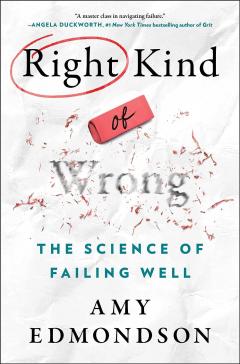
Amy C. Edmondson’s “Right Kind of Wrong: The Science of Failing Well” is a calm, evidence-based corrective to that reflex. The book doesn’t glorify failure. It classifies it. It distinguishes preventable mistakes from unavoidable complexity — and separates both from the kind of intelligent, well-designed experiments that make progress possible.
If your company is “failing” a lot, you might be reckless.
If your company is “never failing,” you might be stagnant.
The leadership skill is knowing which is which — and building a culture that can learn without becoming careless.
Why We Keep Getting Failure Wrong
In boardrooms, I’ve seen two common failure myths.
The perfection myth: “If we hire smart people and plan well, failure should be rare.”
The hero myth: “If something goes wrong, a strong leader fixes it and moves on.”
Both myths are comforting — and both are expensive.
Perfection discourages transparency. People hide minor errors until they become big ones. Heroism discourages systems thinking. We rely on extraordinary effort instead of designing ordinary processes that prevent predictable breakdowns.
Edmondson’s argument is sharper: in modern work — fast, interdependent, uncertain — failure is not a single thing. It’s a category error to treat every setback as incompetence. Failure can be a warning, a system signal, or a discovery engine — depending on where you are operating and why you took the action in the first place.
The Three Archetypes of Failure
Edmondson’s most practical contribution is her framework of three failure archetypes: basic, complex, and intelligent. When leaders label failure correctly, they respond with precision instead of emotion.
These happen in familiar territory — when the proper process is known, and execution should be reliable. Think: missed handoffs, sloppy checks, ignored protocols, and avoidable rework.
Leadership response: reduce ambiguity, strengthen habits, clarify ownership, improve training, and simplify the system.
1) Basic failures: the preventable ones
Basic failures are not “learning opportunities” in the motivational-poster sense. They are operational signals: your system is leaking. If leaders treat them as harmless, they quietly multiply — because teams infer that standards are optional.
2) Complex failures: the system ones
These happen when multiple moving parts interact — technology dependencies, cross-functional trade-offs, supply chain shocks, human judgment under pressure. No single person “caused” it. The system produced it.
Edmondson captures an uncomfortable truth: “At times the line between a basic failure and a complex failure blurs.”
That blurring is exactly why simplistic blame is so tempting — and so wrong.
Leadership response: analyze interdependencies, redesign feedback loops, surface weak signals early, and resist the urge to close the case too quickly.
In my own experience, organizations don’t usually suffer because leaders lack intelligence. They suffer because leaders settle for a story that feels decisive rather than doing the patient work of understanding what actually happened.
3) Intelligent failures: the progressive ones
These are the failures you want more of — small, contained, ethically sound experiments in new territory, where learning is the goal. They happen because answers cannot be knownb in advance.
Edmondson offers a crisp standard: “Good failures are those that bring us valuable new information that simply could not have been gained any other way.”
When leaders design work so that learning is captured — hypotheses stated, risks bounded, results shared — failure becomes a resource rather than a stigma.
Psychological Safety: The Hidden Enabler
Here, Edmondson’s earlier work on psychological safety becomes essential to the science of failing well. People will not report problems, admit errors, or propose uncertain experiments if being wrong is socially punished.
A line from the publisher sample says it plainly: in psychologically safe contexts, “questions are appreciated, ideas are welcome, and errors and failure are discussable.”
And the emotional payoff is not softness — it is focus. People can concentrate on the work because “being wrong won’t be a fatal blow to their reputation.”
This is a leadership design problem. The tone in the first five minutes of a meeting often determines whether the truth enters the room.
A Healthy Failure Culture Isn’t “Anything Goes”
Some leaders hear “fail fast” and interpret it as permission to tolerate sloppy execution. Edmondson’s model is the opposite. It is a framework for being stricter where we should be strict (basic failures), more curious where we must be curious (complex failures), and more courageous where progress requires it (intelligent failures).
She underlines the long-term stakes: “A healthy failure culture rewards intelligent failure. Without it, there can be no innovation.”
That isn’t a trendy statement. It’s a survival statement.
A Practical Failure Playbook for Leaders
To apply this immediately, try this simple protocol the next time something goes wrong:
- Name the failure type: basic, complex, or intelligent?
- Match the response: prevention, systems redesign, or learning acceleration?
- Protect the signal: what uncomfortable information must not be lost?
- Extract learning: what did we learn — specifically — and how will we act on it?
- Share it: who else needs this learning to prevent repetition or build on it?
Notice what this approach removes: courtroom language. And notice what it adds: clarity. When teams know leaders will respond appropriately, they stop hiding reality and start improving it.
The Real Promise of Right Kind of Wrong
This book is not permission to be sloppy. It is permission to be honest.
It gives leaders a language to say:
- “This was preventable — and we will fix the system.”
- “This emerged from complexity — and we will redesign how work flows.”
- “This was a smart experiment — and we are stronger because we learned.”
In an economy where uncertainty is standard, “failing well” is not a soft skill. It is a core capability. The organizations that win are not those that avoid being wrong. They are those that can be wrong in the right way — and turn that wrongness into momentum.
If you’d like to explore the book yourself, you can find it here on Amazon.
As at Amazon Associate, I earn from qualifying purchases. This means that if you click on a link in this post and make a purchase, I may receive a small commission, at no extra cost to you. Your support helps keep The Chairman’s Playbook going, and I’m grateful for it.
Leave a Reply