
Quiet Masterclass in Wealth, Behavior, and “Enough”
“Controlling your time is the highest dividend money pays.” — Morgan Housel
Money is one of the few subjects where smart people routinely do irrational things. Not because they can’t do the math, but because money is never just numbers. It’s memory, identity, fear, pride, comparison, and hope, all wearing a spreadsheet as camouflage.
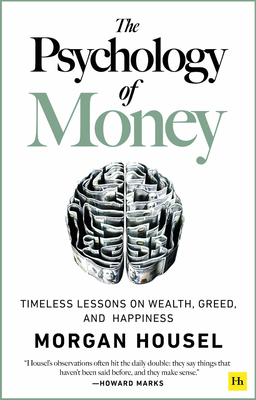
That is why “The Psychology of Money” works so well. Morgan Housel doesn’t impress you with complicated models. He does something rarer: he shows that financial outcomes depend less on intelligence and more on behavior. “Doing well with money has little to do with how smart you are and a lot to do with how you behave.”
I’ve seen this at the board level. People can quickly approve or instantly reject a well-argued investment memo depending on one thing: what they believe about risk, control, and the future. The numbers matter, but the psychology decides.
1) Behavior Beats Brilliance
Most financial mistakes are not calculation errors. They are emotional errors: impatience, envy, fear, and the desire to prove something.
Housel’s point is liberating: you don’t need to be a genius. You need to avoid self-sabotage. Leaders, ironically, are vulnerable here. Because leadership often rewards confidence, we may confuse confidence with control, and control with certainty.
A healthy money mindset asks:
- What am I optimizing for: status or freedom?
- Am I buying things, or purchasing approval?
- Is this risk necessary, or is it ego?
2) Survival Is the Real Strategy
In investing, as in leadership, the goal is not to win every quarter. The goal is to stay in the game. As the author puts it wisely: “The most important part of every plan is planning on your plan not going according to plan.”
In banking, we used to say, “liquidity is oxygen.” You don’t notice it when you have it; the moment it disappears, everything else becomes irrelevant. Housel’s equivalent is “margin of safety”: enough resilience so that a poor year doesn’t become a permanent exit.
Practical takeaway:
Ask yourself: “What event would force me to sell at the worst time or accept work I hate?” Then build buffers against it: cash, lower fixed costs, insurance, and flexibility.
3) The Future Doesn’t Behave Like a Spreadsheet
One reason we make poor decisions is that we trust neat narratives. We want the past to explain the future. But Housel reminds us that a few extreme events shape most financial history. The average year matters less than the rare year that changes everything. “We are not good at predicting the future.”
Leadership is similar: most quarters are routine, then comes a shock that rewrites the rules. Resilience comes from preparing for what is possible, not only what is likely.
Practical takeaway:
Keep a personal “risk register”:
- What could reduce my income unexpectedly?
- What could increase my obligations overnight?
- What could force a rushed decision?
Then design your life so those shocks are inconvenient, not catastrophic.
4) “Enough” Is a Competitive Advantage
If I had to summarize the book in one word, it would be enough. Housel puts it brilliantly: “There is no reason to risk what you have and need for what you don’t have and don’t need.”
Comparison is a silent tax on wealth. The problem is not wanting more; it’s wanting more because someone else has more. There is no finish line in a race that keeps moving.
This is particularly true for leaders because status symbols often disguise themselves as “professional norms.” Yet chasing signals creates a fragile life: high fixed costs, constant pressure, and fewer choices.
Practical takeaway:
Express your definition of enough in one sentence, and treat it as a boundary: “Enough means I can live well and never be forced into decisions I regret.”
5) Wealth Is What You Don’t See
Housel offers one of the cleanest distinctions in personal finance:
- Rich is visible spending.
- Wealth is what remains after spending.
“Wealth is what you don’t see.” — Morgan Housel
This is also a leadership lesson. Some of the best organizational decisions are invisible: saying no, keeping reserves, resisting vanity projects, and avoiding over-expansion in good times. When the cycle turns, the quiet leader with patience becomes the one with options.
Practical takeaway:
Build wealth through what you can control:
- saving rate
- time horizon
- costs and lifestyle inflation
- reasonable risk
6) Reasonable Beats Rational
Many “optimal” plans fail because people can’t stick with them. Housel argues that what matters is a plan you can hold through boredom, volatility, and fear. “A good decision is one that is reasonable.”
The same is true in leadership: the best strategy is not the most elegant; it’s the most executable. A culture is not what you declare; it’s what people can live with day to day.
Practical takeaway:
Choose simplicity that you can sustain: fewer bets, longer time horizons, and more liquidity than feels efficient.
7) Money Buys the Ability to Say “No”
Housel’s most human point is also the most powerful: the best use of money is to gain autonomy over time and choices. “The ability to do what you want, when you want… is priceless.”
Leaders become compromised when they need outcomes: the next bonus, the next deal, the next title. Need creates pressure. Pressure creates shortcuts. Shortcuts create regret.
Financial independence is not about retiring early. It’s about living and leading from principle rather than panic.
Closing Reflection
Reading “The Psychology of Money” for hot tips will disappoint you. If you read it to understand human behavior, you’ll be strengthened. “Good investing is not necessarily about making good decisions. It’s about consistently not screwing up.”
Money is not a topic to “solve.” It’s a relationship to manage. And like every meaningful relationship, it improves when you replace ego with clarity and comparison with purpose.
If you’d like to explore the book yourself, you can find it here on Amazon.
As an Amazon Associate, I earn from qualifying purchases. This means that if you click on a link in this post and make a purchase, I may receive a small commission, at no extra cost to you. Your support helps keep The Chairman’s Playbook going, and I’m grateful for it.
Leave a Reply