
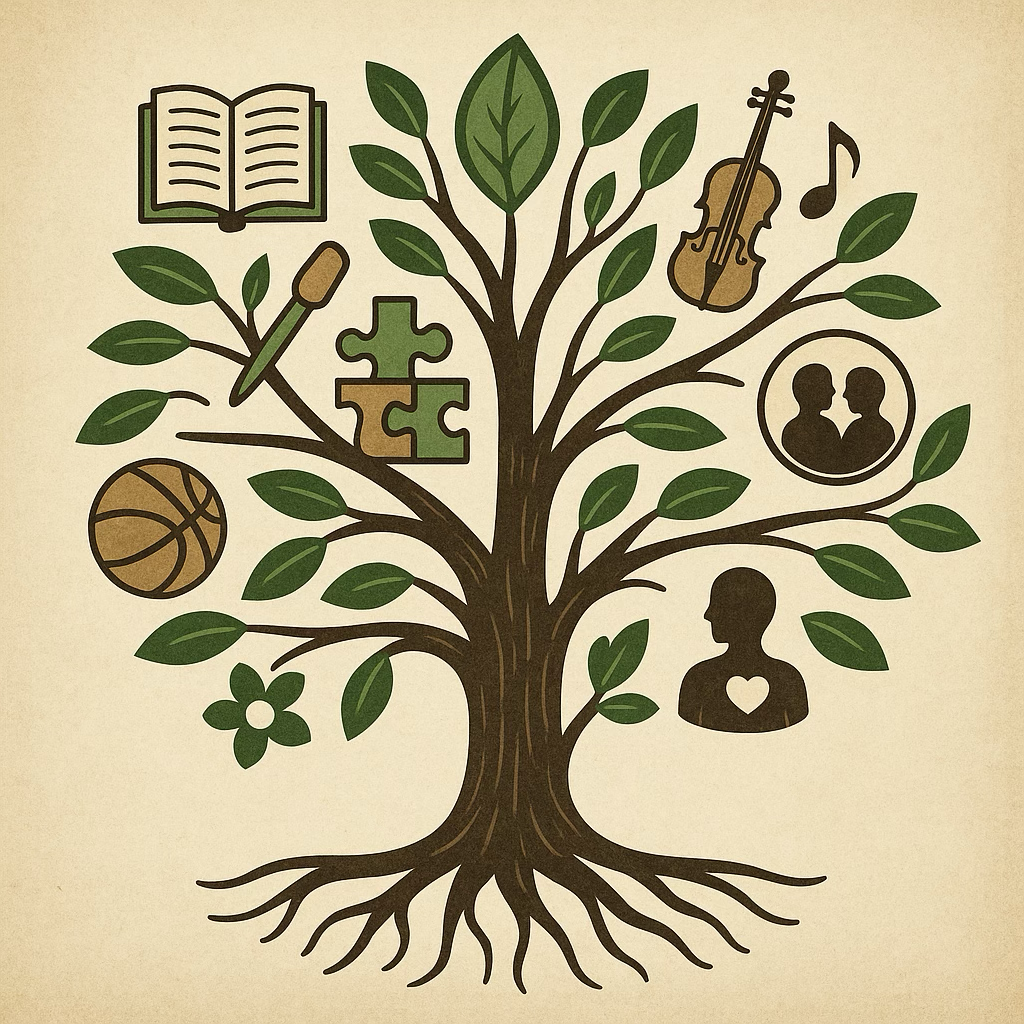
“It’s not how smart you are that matters, it’s how you are smart.” — Howard Gardner
First Reading: A Revolution in Thinking
Thirty years ago, I encountered Howard Gardner’s “Frames of Mind”. It struck me like a thunderbolt. Until then, intelligence had meant grades, tests, or professional success. Gardner’s theory of multiple intelligences opened a new window. Suddenly, the strengths I saw in colleagues, friends, family, or myself had a name. Gifts that had been invisible or undervalued were now recognized as intelligence in their own right.
I was especially struck by Gardner’s phrase: “It’s not how smart you are that matters, it’s how you are smart.” That single sentence reframed the whole question of intelligence. It made me realize that the real challenge of leadership is not ranking people by some narrow measure, but recognizing the unique ways their intelligence, and hence their inborn gifts, can shine.
That first reading changed the way I saw people and shaped my thoughts about talent, vocation, and leadership.
The Seven Intelligences at a Glance
When “Frames of Mind” was first published in 1983, Gardner identified seven intelligences, each reflecting a different kind of inborn gift or talent:
- Linguistic – sensitivity to words, language, and expression.
- Logical-mathematical – reasoning with numbers, patterns, and systems.
- Spatial – thinking in images, visualizing, and designing.
- Bodily-kinesthetic – learning through movement, craft, or physical skill.
- Musical – attunement to rhythm, pitch, and sound.
- Interpersonal – understanding and relating well to others.
- Intrapersonal – insight into one’s own feelings, motives, and strengths.
Reflecting on Myself
Looking back at that stage of life, I realized I carried consistent doses of the first two intelligences (linguistic and logical-mathematical) and the last two (interpersonal and intrapersonal). The others were present, but to a lesser degree.
I also noticed something important: only the first two intelligences — linguistic and logical-mathematical — are measured by the classic IQ tests. The last two — interpersonal and intrapersonal — combine to form what we now call emotional intelligence, or EQ. Seeing that distinction helped me understand why some brilliant people struggled in leadership, while others with strong EQ flourished even without dazzling test scores.
This self-awareness became a foundation for my approach to leadership and growth. It showed me not just where my strengths lay but also which capacities I might need to develop more intentionally.
Second Reading: New Lenses, Deeper Reflections
Fifteen years later, I returned to Gardner’s work as I prepared for a leadership masterclass with my senior colleagues at Unicredit Romania. By then, Gardner had expanded his theory to include an eighth intelligence: Naturalistic — a sensitivity to patterns in the natural world.
In those years, I had also read countless books on leadership, coaching, psychology, and vocation. I had lived through the daily realities of leading teams, navigating crises, and seeing people flourish or stall.
This time, the book spoke differently. It wasn’t just theory. I could map Gardner’s intelligences directly onto people I knew:
- A colleague whose naturalistic intelligence brought clarity to complex systems.
- A manager whose interpersonal gifts made teams feel seen and heard.
- An analyst whose logical-mathematical mind cut through confusion.
The re-reading wasn’t simply an intellectual exercise: it was a mirror. I saw myself differently, and I saw my colleagues with greater nuance.
Growing the Intelligences
One of the most critical shifts in my second reading was realizing that intelligences are not fixed. Gardner himself called them “potentials” that can be nurtured. Life experience, deliberate practice, and the right environment, all deepen our capacities.
Specifically for interpersonal and intrapersonal intelligences:
- Interpersonal (understanding others)
Even if you’re not naturally “people-smart”, you can grow this through intentional practice:- Active listening (reflecting what you hear).
- Asking open-ended questions.
- Observing body language and group dynamics.
- Seeking feedback on how others experience you.
- Intrapersonal (understanding self)
This often grows through reflection and habits of self-awareness:
- Journaling your thoughts and emotions.
- Practicing mindfulness or meditation.
- Setting aside time to review your decisions and reactions.
- Seeking mentors or coaches who can mirror back patterns you might not see.
Some people may never feel as natural at these intelligences as someone innately gifted, but development is absolutely possible, and often transformational for leaders.
Leadership Implications
Attempting to strengthen these intelligences makes you a better leader, because it shows humility and a willingness to grow. Teams usually notice and appreciate that.
That second reading also reminded me that leadership isn’t about rewarding only the “obvious” intelligences. Too often, organizations prize analysis (logical) and communication (linguistic), while neglecting the rest. Yet when we build teams, we need diversity across the spectrum.
The responsibility of a leader is twofold:
- To know your own blend of intelligences. Self-awareness helps you lead authentically.
- To notice and nurture the intelligences of others. Great leaders make space for hidden gifts to flourish.
This was the conversation I wanted to bring to my Unicredit colleagues, not just an academic framework, but a practical leadership lens.
Closing Thought
Books change because we change. Reading Gardner’s work the first time was like discovering a new world; and reading it the second time was like seeing my own world more clearly.
The lesson that stayed with me was that intelligences are not just labels for what we already are. They are invitations to grow into what we might become. Leadership, at its best, is about creating environments where that growth is possible for everyone.
Questions for Reflection
- How has your understanding of intelligence changed since childhood?
- Which of Gardner’s intelligences felt most natural to you early in life?
- Which ones have you consciously developed over time?
- What new “lenses” do you bring when you revisit books or ideas?
- How do you create space in your leadership for others to grow their intelligences?
✅ Next Tuesday in The Chairman’s Playbook: the second element of vocation, Developing Skills.
📚Further Reading:
- Howard Gardner – Frames of Mind: The Theory of Multiple Intelligences
The foundational text where Gardner first introduced his theory of seven intelligences in 1983. - Howard Gardner – Intelligence Reframed: Multiple Intelligences for the 21st Century
Gardner’s later work, where he added Naturalistic Intelligence and reflected on the theory’s broader implications. - Daniel Goleman – Emotional Intelligence: Why It Can Matter More Than IQ
A seminal book showing how interpersonal and intrapersonal intelligences (EQ) shape leadership and success. - Thomas Armstrong – Multiple Intelligences in the Classroom
A practical guide for applying MI theory in education—useful for leaders, coaches, and mentors as well. - Marcus Buckingham & Donald Clifton – Now, Discover Your Strengths
A strengths-based approach that resonates with the idea of recognizing and cultivating different intelligences.
Disclosure: As an Amazon Associate, I earn from qualifying purchases. This means that if you click on a link in this post and make a purchase, I may receive a small commission, at no extra cost to you. Your support helps keep The Chairman’s Playbook going, and I’m grateful for it.
Leave a Reply