
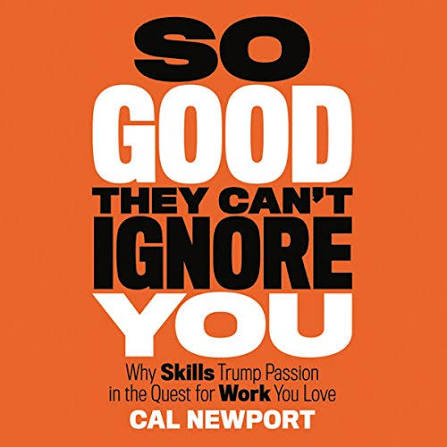
“Follow your passion” is advice we’ve all heard, and maybe even given. It sounds uplifting, even liberating. But is it actually useful? In his book, “So Good They Can’t Ignore You”, Cal Newport argues that it might be some of the worst advice. Instead, he suggests something more practical and powerful: build skills so valuable that the world can’t help but take notice.
The Passion Trap
Newport begins by challenging one of the most pervasive career myths: that passion should guide our choices. According to him, this mindset leads to the passion trap, a cycle of dissatisfaction and restlessness. People jump from one job to another searching for passion, but rarely find lasting fulfillment.
He puts it bluntly: “Passion is not something you follow. Passion will follow you as you work hard to become valuable to the world.”
I’ll admit, I’ve been guilty of this approach myself. In moments of career doubt, it’s tempting to believe that out there somewhere, there is a “perfect fit” waiting for me. Newport reminds us that this mindset is flawed. Passion is often the result of mastery, not the starting point.
This idea connects closely to what I wrote in “What Is Success?”, which states that true fulfillment often comes not from chasing external validation, but from deepening our craft and impact.
Self-Determination Theory and Motivation
Newport’s challenge echoes what psychologists Edward Deci and Richard Ryan describe in Self-Determination Theory (SDT), a framework for understanding motivation. According to SDT, we thrive when three psychological needs are met:
- Autonomy — control over how we work.
- Competence — the belief we’re good at what we do.
- Relatedness — a sense of connection with others.
When these needs are fulfilled, intrinsic motivation flourishes, with higher levels of job satisfaction.
Newport’s idea of career capital, the rare and valuable skills we develop, provides the leverage to meet these needs. Mastery brings competence, skill creates autonomy, and excellence earns respect that deepens relationships.
Career Capital: The Real Currency
Instead of chasing passion, Newport urges us to build career capital. These rare skills become the currency that buys freedom, impact, and satisfaction. As he postulates, “If you want to love what you do, abandon the passion mindset (‘what can the world offer me?’) and instead adopt the craftsman mindset (‘what can I offer the world?’).”
Violinists don’t love their instrument simply because of passion; they love it because, after years of practice, they’re good at it. Competence breeds confidence, and confidence breeds joy.
The same holds in leadership. The leaders we admire aren’t those who stumbled into dream roles. They are the ones who showed up, practiced, failed, and improved until their expertise became undeniable.
The Craftsman Mindset
The craftsman mindset is at the heart of Newport’s argument, focusing relentlessly on what one can offer the world rather than what the world can provide one with. As he wisely put it: “No one owes you a great career. You need to earn it, and the process won’t be easy.”
It’s the opposite of entitlement. Instead of asking, “Is this job making me happy?” you ask, “How can I become so good at this that my work is impossible to ignore?”
When you adopt the craftsman mindset, you will not hesitate to take action to improve the quality of your work. And you can do it through deliberate practice, which stretches one’s abilities, and from which constructive feedback is sought.
Without career capital acquired by adopting the craftsman mindset, you will never have autonomy in your job. That is because until you’ve proven your competence and mastery, others will not give you control over your work.
Takeaway for Leaders
The craftsman mindset is especially relevant for leaders. Leadership isn’t about titles or passion but consistency, skill, and value. Whether you’re building trust in your team, sharpening strategy, or learning to communicate with clarity, every hour of focused practice compounds into leadership capital.
If you’re leading others, Newport’s message is doubly important. Passion-driven advice can set your team up for disappointment when reality gets hard. Skill-driven advice, however, builds resilience.
As leaders, we can model the craftsman mindset, showing that excellence comes not from chasing passion but from practicing it. And when we encourage others to build career capital, we help them unlock autonomy, meaning, and fulfillment the right way: by earning it.
So perhaps the authentic leadership mantra isn’t “follow your passion,” but rather “Be so good they cannot ignore you.”
A Personal Reflection
Looking back on my own career, the moments I felt most “passionate” weren’t when I was chasing novelty. They were when I had grown competent enough to make a difference.
I think of times I was trusted to lead, teach, or create something meaningful. Passion wasn’t the starting point; it was the byproduct of persistence and the willingness to improve things I wasn’t initially good at.
That realization is deeply freeing: I don’t have to find my passion; I have to build it.
Final Thoughts
Cal Newport’s message may feel countercultural in a world that tells us to “do what you love, ” but his challenge is refreshing and practical: stop chasing passion and start cultivating excellence. As Newport articulates: “If your goal is to love what you do, you must first build up rare and valuable skills.”
For leaders, this means modeling the craftsman mindset and creating environments where autonomy, mastery, and connection thrive. For individuals, it means embracing the process of becoming, not just dreaming of what might be.
Ultimately, the truth is simple: passion is not discovered, but earned. And when paired with autonomy, competence, and relatedness, it becomes the foundation of fulfillment and authentic leadership. One of Newport’s concluding pointers resonated with me:
“Stop worrying about what you feel like doing, and instead work on becoming so good at something that the world will be forced to notice.”
If you’d like to explore the book yourself, you can find it here on Amazon.
Disclosure: As an Amazon Associate, I earn from qualifying purchases. This means that if you click on a link in this post and make a purchase, I may receive a small commission, at no extra cost to you. Your support helps keep The Chairman’s Playbook going, and I’m grateful for it.
Leave a Reply