
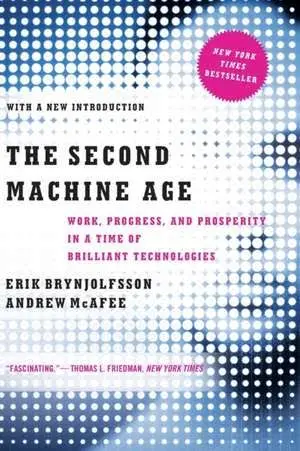
“Now comes the second machine age.”
That single line captures the book’s core claim: the Industrial Revolution multiplied muscle power; today’s digital revolution is multiplying mental power — our ability to sense, decide, predict, and coordinate at scale.
If you lead people — especially in a world where AI is no longer a side project — “The Second Machine Age” focuses less on technology and more on the new terrain of value: where people create it, how they capture it, and why it spreads so unevenly.
The curve leaders keep underestimating
One of the most practical warnings in the book is not about robots; it’s about our intuition.
“The greatest shortcoming of the human race is our inability to understand the exponential function.”
Leaders routinely plan for linear change: modest efficiency gains, gradual adoption, incremental productivity. But digital progress compounds — then suddenly feels like it “came out of nowhere.” In real life, this is the moment a competitor’s product gets good enough, the customer switches habits, and your strategic plan becomes a historical document.
Brynjolfsson and McAfee explain why this acceleration happens by pointing to three qualities of modern technologies:
“Not only are the new technologies exponential, digital, and combinatorial…”
Exponential means the capability grows faster than our forecasts. Digital means replication is cheap, and distribution is instant. Combinatorial means innovation stacks — new tools are built from existing blocks, recombined again and again.
This is why leadership in the second machine age is not “keeping up with trends.” It is building an organization that can learn faster than the environment changes.
The big paradox: more prosperity, more imbalance
The book’s most useful leadership frame is the tension between bounty and spread.
- Bounty: technology can produce more abundance — better products, services, speed, convenience, and new capabilities that create real wealth.
- Spread: gains can concentrate—widening inequality and rewarding those who can scale, automate, and differentiate.
This isn’t a political argument so much as a systems one. In the second machine age, a company (or a country) can improve headline numbers while many people feel left behind.
The authors sharpen this into a sentence leaders should sit with: “There’s never been a better time to be a worker with special skills… however… never been a worse time… with only ‘ordinary’ skills.”
If you run an organization, that “spread” is not abstract. It shows up in morale, turnover, union pressure, trust, employer brand, and the subtle resentment that grows when productivity rises but opportunity doesn’t.
The leadership question that replaces the fear question
Many executives still ask, “Will machines replace our people?”
The better question — the one The Second Machine Age nudges us toward — is: “Where do humans and machines together beat either alone?”
What changes inside an organization?
The point isn’t that machines do everything. It’s that machines increasingly do some tasks that used to define “knowledge work” — search, classification, drafting, prediction, triage. That shifts human advantage toward what remains difficult to digitize: judgment in messy contexts, trust-building, ethics, creativity, storytelling, and the design of good decisions.
Or, in a line, the book quotes approvingly: “No machine can do the work of one extraordinary man.”
Your strategic job as a leader is to create more “extraordinary” work — and reduce the time your best people spend on tasks that are becoming ordinary.
In the first machine age, machines were visible: factories, engines, assembly lines. In the second, the machine is often invisible: software, models, platforms, networks. This changes how organizations win.
1) Strategy becomes a speed contest — of learning, not just execution.
When technology is combinatorial, advantage goes to the firm that tests more ideas and recombines faster — not the firm with the thickest binder of “best practices.”
2) Culture becomes a productivity lever.
If your culture punishes experimentation, the organization learns slowly. In a linear world, that’s survivable. In an exponential world, it’s fatal.
3) The talent deal must evolve.
The spread problem is partly a skills mismatch problem. Organizations that invest in continuous reskilling don’t just fill roles — they reduce anxiety and raise loyalty.
Six moves I would take from this book into the boardroom
- Treat “digital” as a redesign, not an upgrade. Don’t automate a broken workflow — rethink it end-to-end.
- Build an experimentation engine. Short cycles, objective metrics, clear kill rules. In combinatorial innovation, volume and speed matter.
- Make complementarity a strategy. Pair top talent with tools that amplify them (AI copilots, analytics, automation) and redesign roles so humans do the highest-leverage work.
- Audit “ordinary work.” Identify where capable people are spending time on increasingly automatable tasks — and move that work to systems.
- Manage the spread inside your walls. Pay attention to career mobility, access to training, and fairness. Unmanaged spread becomes cynicism, and cynicism kills performance.
- Keep a human thesis. Technology speeds up capability; it does not automatically create meaning. Leaders must anchor purpose, dignity, and trust while the tools change.
The book’s quiet challenge
“The Second Machine Age” is fundamentally optimistic — but it refuses naïve optimism. It insists that outcomes are not automatic. They are shaped by choices: by incentives, institutions, and leadership.
If you lead a business today, you are not just “adopting technology.” You are participating in the design of a new economic era inside your own walls: how value is created, who benefits, what skills matter, and what kind of work remains deeply human.
That’s why this book still belongs on a leader’s shelf. Not because it predicts every tool correctly, but because it teaches you how to think when the curve starts bending.
If you’d like to explore the book yourself, you can find it here on Amazon.
As an Amazon Associate, I earn from qualifying purchases. This means that if you click on a link in this post and make a purchase, I may receive a small commission, at no extra cost to you. Your support helps keep The Chairman’s Playbook going, and I’m grateful for it.
Leave a Reply